A Practical Approach to 18th Century Counterpoint, Revised Edition
A Practical Approach to 18th Century Counterpoint
A valuable method for students, composers, and teachers who want to connect Baroque counterpoint with analysis, voice leading, historical sources, and real writing practice.
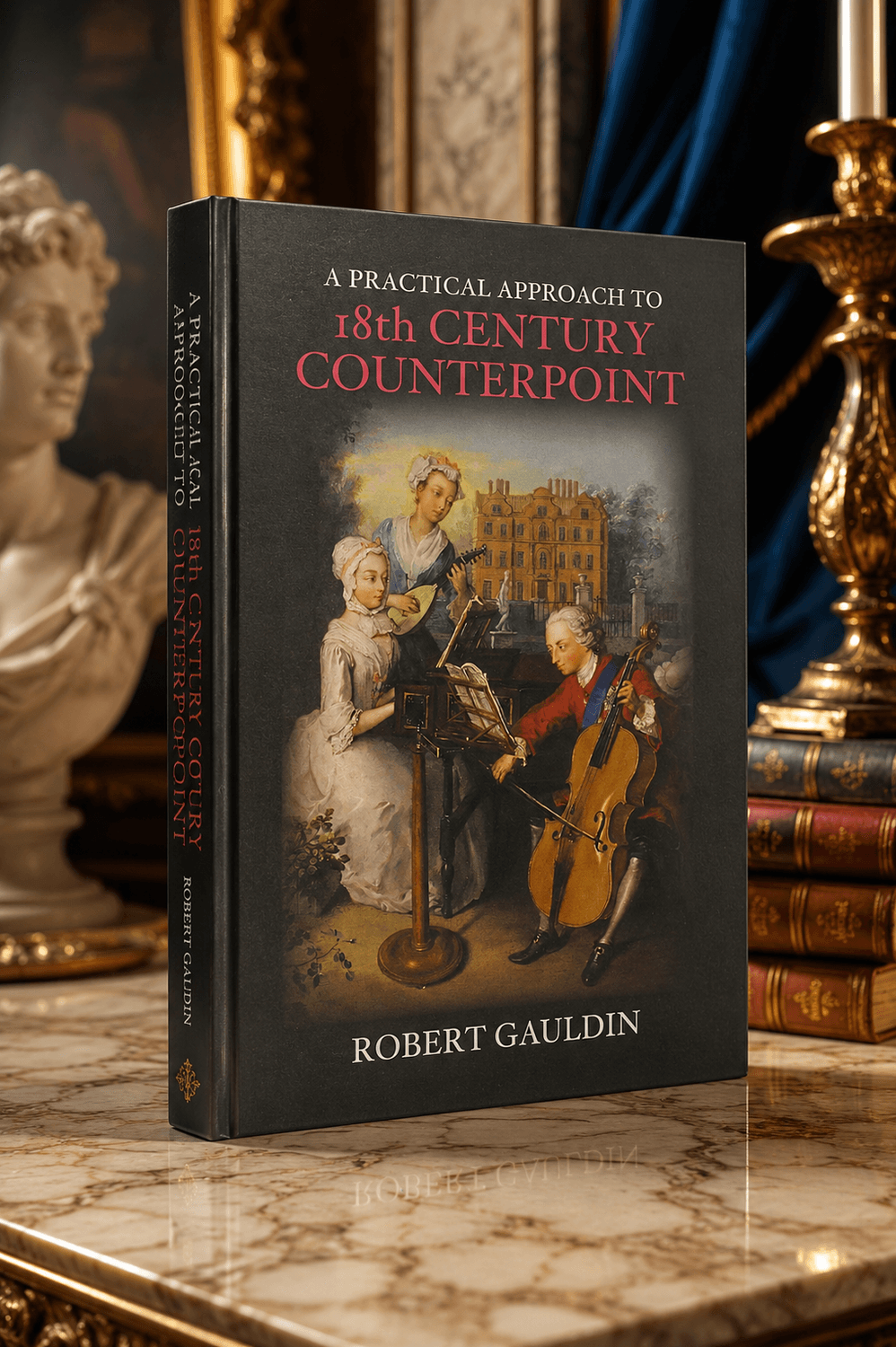
Book Description
A Practical Approach to 18th Century Counterpoint, Revised Edition by Robert Gauldin is a detailed and hands on textbook for studying eighteenth century counterpoint, late Baroque polyphony, imitation, canon, invention, chorale prelude, fugue, and choral writing. The book develops writing and analysis together, moving from melody and two voice textures toward three and four voice counterpoint, chromaticism, invertible counterpoint, and larger forms. It is especially valuable for students, composers, teachers, keyboardists, and historically minded musicians who want counterpoint to become a practical craft, not just a theory topic.
Who this book is for?
This book is ideal if you want to:
Study Baroque counterpoint through writing.
Practice imitation, canon, and invention.
Understand fugue from the inside.
Improve voice leading and texture control.
Connect analysis with composition skills.
What will you learn?
In A Practical Approach to 18th Century Counterpoint, you will learn how contrapuntal thinking works in the late Baroque period, especially through practical writing, stylistic awareness, and analysis.
The book begins with general features of the period and then moves into melody, two voice counterpoint, simple diminution, rhythmic elaboration, chorale preludes, free counterpoint, and two reprise forms. This gradual path is useful because it does not throw the student directly into fugue before the hand and ear understand basic contrapuntal motion.
You will also learn how more advanced techniques grow from simpler ones. The table of contents includes real imitation, double counterpoint, canon, invention, three voice texture, chromaticism, tonal imitation, invertible counterpoint, fugue, four voice texture, variations, choral writing, and Classical period counterpoint.
Book Overview
This review of A Practical Approach to 18th Century Counterpoint can be summarized clearly: it is a serious but practical method for learning eighteenth century contrapuntal writing through exercises, analysis, and historical context.
The revised edition was published by Waveland Press in 2013. The publisher lists the book as 335 pages, ISBN 9781478604709, in plastic comb format, which is actually useful for a counterpoint workbook because it can stay open on the desk while you write.
As a summary, Gauldin’s method stresses three things: practical work in writing counterpoint, historical background for the forms and methods being studied, and analysis of music literature, often through voice leading reductions. This makes the book more than a rule manual. It is a bridge between what you write on paper and what you hear in actual Baroque repertory.
Is it worth it? Yes, especially if you want a structured path into eighteenth century counterpoint. Many students admire Bach but do not know how to move from admiration to craft. Gauldin gives a staircase: note against note, diminution, imitation, canon, invention, chorale prelude, fugue. It is not magic, but it is a very useful workshop.
Topics Covered
Foundations of late Baroque counterpoint and period style.
Practical study of melody, line, and contrapuntal motion.
Exercises in two voice counterpoint and diminution.
Work on chorale prelude texture and elaboration.
Training in real imitation, canon, and invention.
Advanced study of invertible counterpoint and fugue.
Applications to four voice writing, variation, and choral style.
About the Author
Robert Gauldin was an American composer, theorist, and professor emeritus of music theory at the Eastman School of Music. Eastman records that he earned degrees in composition and theory, began teaching at Eastman in 1963, and retired in 1997 after thirty four years of service.
Gauldin published widely, wrote three widely used textbooks, and was active in major music theory organizations. Eastman notes that he served as vice president and president of the Society for Music Theory from 1988 to 1992.
This background matters because A Practical Approach to 18th Century Counterpoint reflects both the composer’s desk and the theory classroom. Gauldin understands counterpoint as something to analyze, explain, and write. That combination is exactly what students need when they want to understand Baroque style as a living musical grammar.
Why this book is worth it
A Practical Approach to 18th Century Counterpoint is worth it because it teaches counterpoint as an active skill. You do not simply learn labels such as canon, invention, or fugue. You learn the smaller decisions that make those forms possible: line, interval, rhythm, imitation, invertibility, sequence, cadence, and texture.
For composers, the book is valuable because it develops control over voice leading, contrapuntal texture, tonal imitation, and formal growth. These skills remain useful even outside Baroque style because they train musical thinking at a deep structural level.
For students, it offers a logical progression from simple exercises to richer textures. The movement from two voices to three and four voices is especially helpful because it mirrors the way real contrapuntal fluency develops.
For teachers, the book is useful because it combines historical background, writing assignments, and analysis. This makes it easier to teach counterpoint as music, not as a punishment invented by theorists with too much ink.
For readers of Musicus Practicus, this book fits naturally beside partimento, harmony, counterpoint, and historical composition methods. It shows how eighteenth century style can be learned through practice, structure, and careful listening.
Buy this Book on Amazon
You can buy A Practical Approach to 18th Century Counterpoint, Revised Edition by Robert Gauldin on Amazon. If you study Baroque counterpoint, fugue, canon, invention, chorale prelude, or historical composition, this is a strong practical book to consider.
It is especially recommended if you want a method that combines writing, analysis, and historical style in one disciplined path.
FAQ on this Book
What makes Gauldin’s book practical?
The book is practical because it centers on writing counterpoint, not only reading about it. It builds skills through exercises in melody, diminution, imitation, canon, invention, fugue, and choral writing.
Is this book mainly about Bach style?
The focus is the broader late Baroque contrapuntal style, so it is highly relevant to Bach, but it also addresses general eighteenth century techniques and Classical period extensions.
Does it teach fugue step by step?
Yes. The book prepares fugue through earlier work in two voice counterpoint, imitation, canon, invention, three voice texture, invertible counterpoint, and tonal planning.
Continue Your Journey as a Musicus Practicus
If you desire to stop looking at early music from the outside and wish to step inside the musical mind of the 15th and 16th centuries, there are three distinct ways we can work together to elevate your skills:
- 1-to-1 Musical Apprenticeship: For a personalized, tailor-made path, book private lessons with me. We will work directly on your specific goals, from counterpoint to improvisation, Renaissance and Baroque composition, theory and practice, exactly as a master and apprentice would have done centuries ago.
- Patreon Support & Exclusive Content: Join our growing community of true Musici Prattici on Patreon!
Gain access to exclusive insights, behind-the-scenes materials, and support the ongoing creation of these deep-dive musical analyses.- The Musicus Practicus Academy (MPA): Enroll in my comprehensive on-demand courses.
Start with the free levels, and master the art of Renaissance and Baroque music step-by-step at your own pace.



All Rights Reserved - Richardus Cochlearius 2026