Capturing Music The Story of Notation
Capturing Music The Story of Notation
A vivid history of Western music notation, from medieval neumes and chant manuscripts to Guido of Arezzo and the gradual invention of readable musical writing.
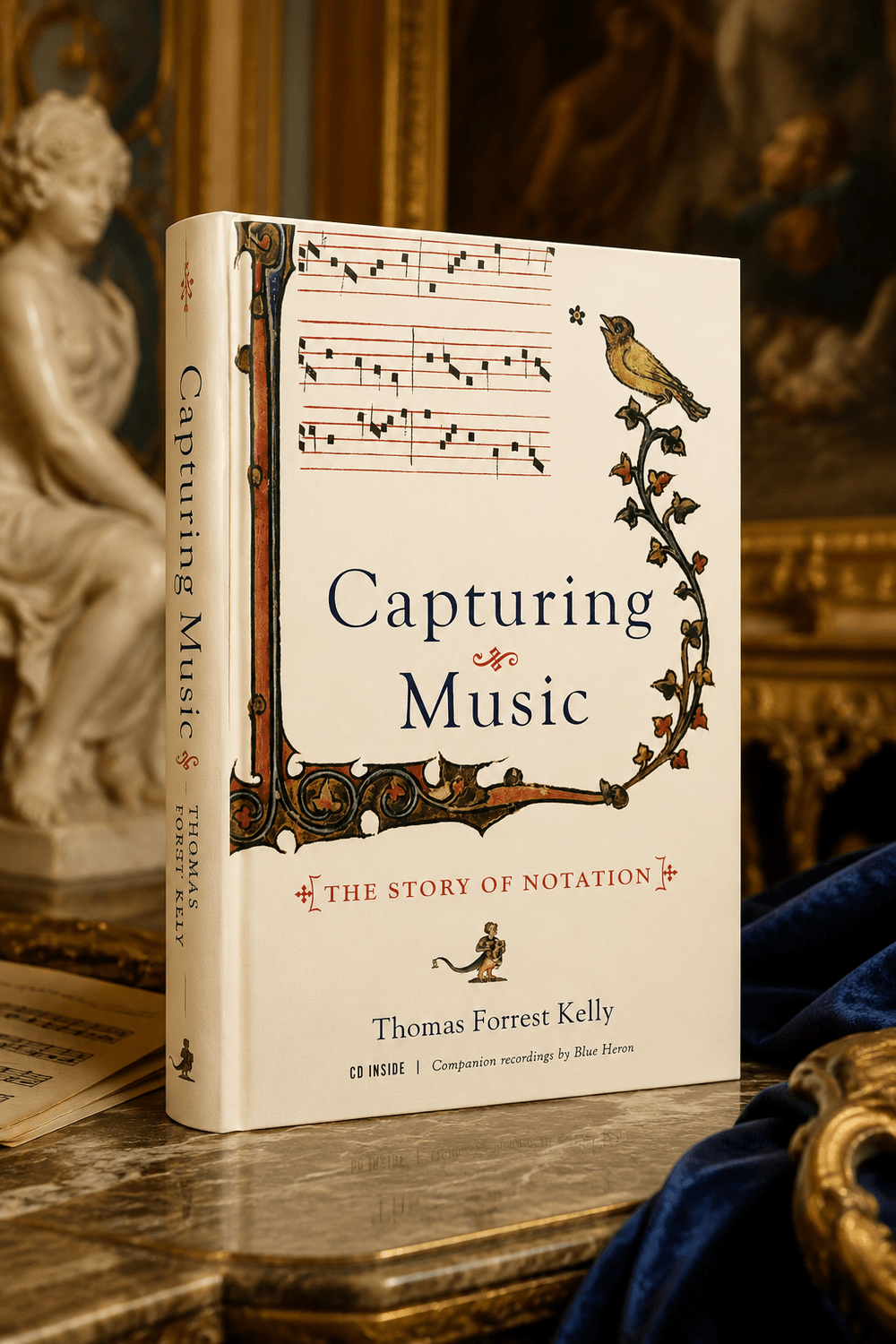
Book Description
Capturing Music: The Story of Notation by Thomas Forrest Kelly is an engaging history of Western music notation, medieval chant, neumes, manuscripts, musical memory, and the long effort to write sound on the page. Rather than treating notation as a neutral tool, Kelly shows it as a cultural and technological invention that changed how musicians learned, remembered, composed, and transmitted music. It is especially valuable for students, performers, teachers, composers, and early music readers who want to understand why notation both reveals and hides the music it tries to preserve.
Who this book is for?
This book is ideal if you want to:
Understand music notation historically.
Explore medieval chant and neumes.
Learn why Guido of Arezzo matters.
Connect memory with musical writing.
Read early music with sharper eyes.
What will you learn?
In Capturing Music, you will learn how Western musicians gradually moved from oral transmission and memory toward systems that could preserve music visually.
The book explains that early notation did not begin as the fully precise staff notation we know today. It started with signs that helped singers remember music they already knew, especially in the world of medieval chant, liturgy, and manuscript culture.
You will also learn why notation is never innocent. Every system chooses what to show and what to leave out. A neume, a staff line, a clef, or a rhythmic sign is not only a technical mark. It reveals what a musical culture considered important enough to capture.
Book Overview
This review of Capturing Music: The Story of Notation can be summarized simply: it is one of the most approachable books for understanding how Western music learned to become visible.
The book was published by W. W. Norton & Company in 2014. Amazon lists the publication date as November 3, 2014, with ISBN 9780393064964, while the UCLA ECHO review describes the volume as xv plus 238 pages, with illustrations, musical examples, appendix, endnotes, bibliography, index, and an audio CD.
As a summary, Kelly follows the story of notation across centuries, giving special attention to early signs, chant, medieval manuscripts, and the decisive conceptual shift that made it possible for written music to become more than a memory aid.
One of the central figures is Guido of Arezzo. Modern summaries of the book emphasize Guido’s role in creating a practical system that allowed singers to learn music with a new degree of precision. In other words, he helped make music readable in a way that changed teaching forever.
Is it worth it? Yes, especially if you want a book that is scholarly without feeling like a locked archive. Kelly turns notation into a story of invention, memory, pedagogy, technology, and human stubbornness. After all, trying to trap music on a page is a little like trying to bottle a bird in flight, absurd, ambitious, and somehow brilliant.
Topics Covered
The early history of Western music notation.
The role of memory in musical transmission.
Development of neumes and chant signs.
Importance of Guido of Arezzo and staff notation.
Links between manuscripts, teaching, and performance.
How notation shaped composition and musical thought.
A bridge between music history, theory, and practice.
About the Author
Thomas Forrest Kelly is an American historical musicologist associated with Harvard University. Harvard’s Medieval Studies profile describes his interests as including music in Christian liturgy, chant, and medieval performance practice.
He has held the title of Morton B. Knafel Professor of Music at Harvard and is known for work on medieval music, chant, and historically informed musical culture. An edX biography notes that he received his BA from the University of North Carolina at Chapel Hill and his PhD from Harvard, and that he is a member of the American Academy of Arts and Sciences.
This background matters because Capturing Music is not just a pretty book about old manuscripts. It is written by someone who understands the technical, liturgical, and practical worlds behind those marks.
Why this book is worth it
Capturing Music is worth it because it changes the way you look at a score. After reading it, notation no longer seems like a transparent window onto music. It becomes a historical artifact, a teaching device, a memory machine, and sometimes a very clever compromise.
For performers, the book is valuable because it reminds us that notation must be interpreted. Early musical signs often assume knowledge that is not written down. That means performance practice, chant, rhythm, and melodic shape require historical imagination.
For composers and theorists, the book shows how notation can shape musical thought. Once music can be written in a new way, musicians can also compose, organize, and remember it in new ways. Notation does not merely record music. It can change what music becomes.
For readers of Musicus Practicus, this book fits naturally beside counterpoint, partimento, modal theory, and historical composition methods. It reminds us that practical theory begins with a simple but profound question: how did musicians learn to make sound visible?
Buy this Book on Amazon
You can buy Capturing Music: The Story of Notation by Thomas Forrest Kelly on Amazon. If you study music notation, medieval music, chant, early music performance, or historical music theory, this book is a rich and enjoyable addition to your library.
FAQ on this Book
Is Capturing Music a technical notation manual?
No. Capturing Music is more a historical and cultural story of notation than a technical manual. It explains how notation developed and why it mattered.
Is Capturing Music good for beginners?
Yes. It is accessible for curious readers, but still serious enough for students, performers, and musicians interested in medieval notation and early music.
Does the book include illustrations or examples?
Yes. Reviews and bibliographic descriptions mention illustrations, musical examples, and an audio CD, making the book more visual and practical than a plain historical survey.
Continue Your Journey as a Musicus Practicus
If you desire to stop looking at early music from the outside and wish to step inside the musical mind of the 15th and 16th centuries, there are three distinct ways we can work together to elevate your skills:
- 1-to-1 Musical Apprenticeship: For a personalized, tailor-made path, book private lessons with me. We will work directly on your specific goals, from counterpoint to improvisation, Renaissance and Baroque composition, theory and practice, exactly as a master and apprentice would have done centuries ago.
- Patreon Support & Exclusive Content: Join our growing community of true Musici Prattici on Patreon!
Gain access to exclusive insights, behind-the-scenes materials, and support the ongoing creation of these deep-dive musical analyses.- The Musicus Practicus Academy (MPA): Enroll in my comprehensive on-demand courses.
Start with the free levels, and master the art of Renaissance and Baroque music step-by-step at your own pace.




All Rights Reserved - Richardus Cochlearius 2026