Companion to Medieval and Renaissance Music
Companion to Medieval and Renaissance Music
A wide ranging guide to medieval and Renaissance music, covering sacred and secular repertories, sources, genres, theory, society, and performance practice.
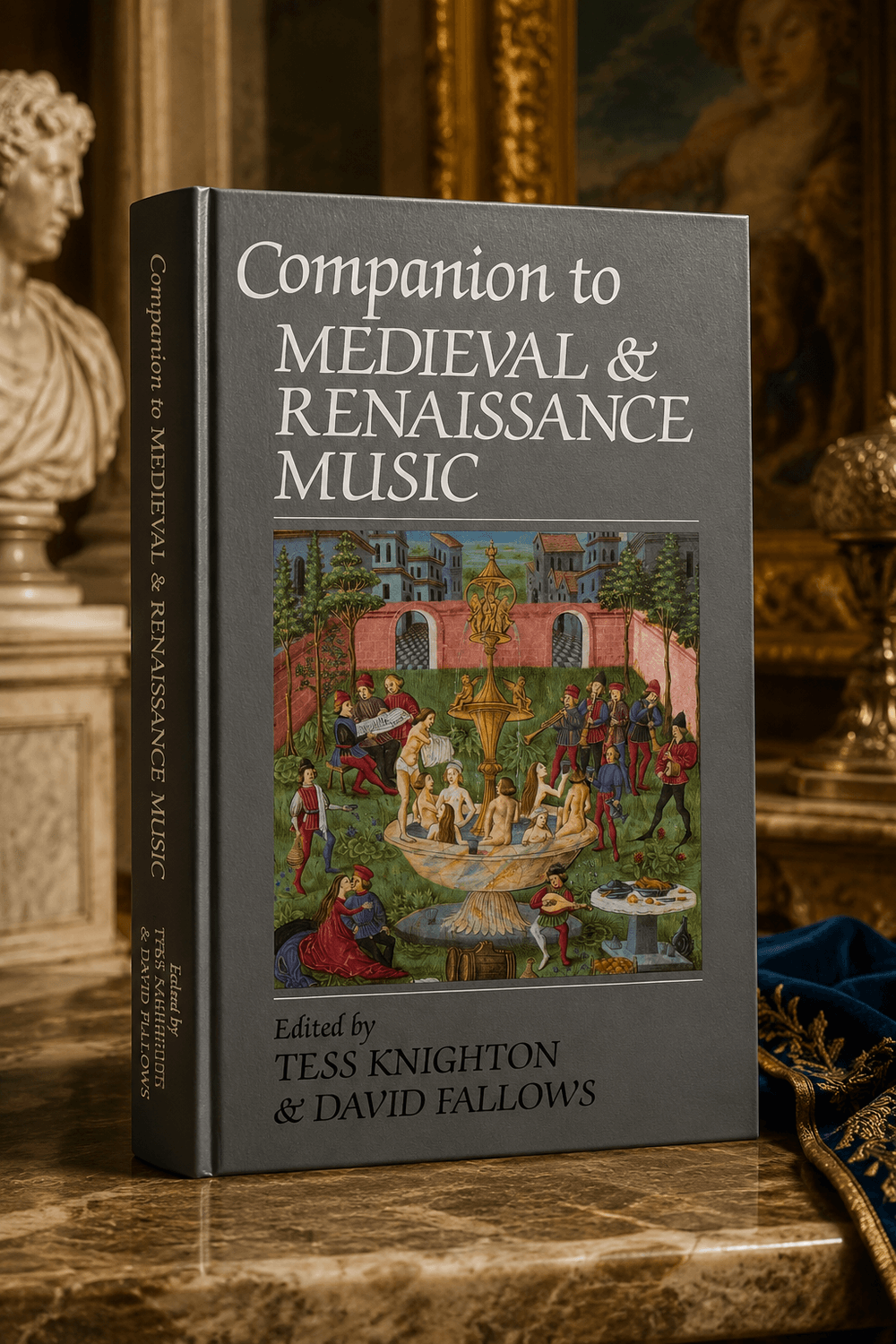
Book Description
Companion to Medieval and Renaissance Music, edited by Tess Knighton and David Fallows, is a lively and wide ranging guide to medieval music, Renaissance music, early music performance practice, musical sources, genres, theory, instruments, and cultural history. With essays by major scholars and performers, the book explores European music from the beginning of the Christian era to 1600. It is especially useful for students, teachers, performers, composers, and curious listeners who want a broad but serious map of the musical world before the Baroque.
Who this book is for?
This book is ideal if you want to:
Explore medieval music with clearer context.
Understand Renaissance music beyond names.
Study early music sources and repertories.
Connect performance practice with history.
Build a broad music history foundation.
What will you learn?
In Companion to Medieval and Renaissance Music, you will learn how medieval and Renaissance music developed within real cultural, social, theoretical, and performance contexts.
The book does not treat early music as a single old sounding style. It opens many doors: chant, polyphony, motets, mass settings, secular song, instrumental repertories, notation, manuscripts, performance practice, instruments, authenticity, and the modern rediscovery of earlier music.
You will also learn why context matters. A medieval motet, a Renaissance chanson, a mass, a keyboard piece, or a wind ensemble does not make full sense if it is separated from patronage, liturgy, court culture, notation, instruments, and the way musicians actually performed.
Book Overview
This review of Companion to Medieval and Renaissance Music can be summarized simply: it is a broad, readable, and serious gateway into the world of early European music.
The book is edited by Tess Knighton and David Fallows and was published by University of California Press in the edition associated with ISBN 9780520210813. Google Books lists the volume as a 1997 University of California Press edition with 428 pages.
The publisher describes the book as a survey of music and culture in Europe from the beginning of the Christian era to 1600, with 50 essays on social, historical, theoretical, and performance contexts. That makes it more than a normal music history textbook. It is closer to a cabinet of expertly chosen windows, each one opening onto a different corner of medieval and Renaissance musical life.
As a summary, the book is divided into large areas such as the modern ear, music and society, form and style, composition techniques, pictures, words, instruments, notation, and performance. The contents listed by the publisher include essays on chant, early Western polyphony, the late medieval motet, mass polyphony, polyphonic song, keyboard music, wind ensembles, and authenticity.
Is it worth it? Yes, especially if you want a book that helps you navigate a huge field without pretending that medieval and Renaissance music can be reduced to a few famous composers and pretty manuscript images.
Topics Covered
Broad context for medieval music and Renaissance culture.
Essays on chant, monophonic song, and early polyphony.
Study of motets, mass polyphony, and vocal genres.
Insight into instrumental music and historical instruments.
Discussion of performance practice and authenticity.
Guidance on sources, notation, manuscripts, and repertories.
A bridge between music history, theory, and performance.
About the Authors
Tess Knighton is a major scholar of late medieval and early modern music, especially music in Iberian courtly, urban, devotional, and ceremonial contexts. Her own website describes her research as focused on Spanish music from about 1450 to the beginning of the seventeenth century, and notes her long engagement with historically informed performance.
Knighton holds MA and PhD degrees from the University of Cambridge, is an Emeritus Fellow of Clare College, Cambridge, and has been an ICREA Research Professor. Her research interests include music and culture in the Iberian world from the fifteenth to the seventeenth centuries.
David Fallows is one of the most influential scholars of late medieval and Renaissance music. A Boydell volume in his honor describes his work as central to studies of Guillaume Du Fay, Josquin Desprez, archival research, biography, sacred and secular music, and reception history.
Together, Knighton and Fallows give this companion a strong identity: scholarly, practical, historically aware, and close to the living world of early music performance.
Why this book is worth it
Companion to Medieval and Renaissance Music is worth it because it gives readers a broad entrance into a difficult repertory without flattening its richness.
For students, it offers a clear way into music history, early polyphony, chant, Renaissance genres, and performance questions. Instead of reading isolated facts, you begin to see how repertories, institutions, notation, and performance habits connect.
For performers, the book is valuable because it constantly reminds us that early music is not only notes on a page. It involves sources, instruments, voices, spaces, language, liturgy, patronage, and choices about authenticity. That is exactly where performance becomes interesting.
For composers and theorists, the book provides a larger background for counterpoint, modal thinking, polyphonic composition, and historical musical grammar. It is not a counterpoint manual, but it helps you understand the world in which that counterpoint lived.
For readers of Musicus Practicus, this book fits naturally beside partimento, counterpoint, harmony, and historical composition methods. It expands the horizon: before learning only how to write in an old style, you begin to understand the culture that made the style meaningful.
Buy this Book on Amazon
You can buy Companion to Medieval and Renaissance Music edited by Tess Knighton and David Fallows on Amazon. If you study medieval music, Renaissance music, early music performance practice, notation, sources, or historical composition, this is a strong reference book to keep nearby.
FAQ on this Book
What period does the book cover?
The book covers European music and culture from the beginning of the Christian era to around 1600, with particular strength in medieval and Renaissance repertories.
Is this book useful for Renaissance polyphony?
Yes. It includes material on mass polyphony, polyphonic song, motets, vocal genres, sources, composition techniques, and the cultural setting of Renaissance music.
Why are there many authors in this book?
Because the field is too wide for one voice. The companion format allows specialists to write on chant, sources, instruments, notation, genres, society, performance, and historical interpretation.
Continue Your Journey as a Musicus Practicus
If you desire to stop looking at early music from the outside and wish to step inside the musical mind of the 15th and 16th centuries, there are three distinct ways we can work together to elevate your skills:
- 1-to-1 Musical Apprenticeship: For a personalized, tailor-made path, book private lessons with me. We will work directly on your specific goals, from counterpoint to improvisation, Renaissance and Baroque composition, theory and practice, exactly as a master and apprentice would have done centuries ago.
- Patreon Support & Exclusive Content: Join our growing community of true Musici Prattici on Patreon!
Gain access to exclusive insights, behind-the-scenes materials, and support the ongoing creation of these deep-dive musical analyses.- The Musicus Practicus Academy (MPA): Enroll in my comprehensive on-demand courses.
Start with the free levels, and master the art of Renaissance and Baroque music step-by-step at your own pace.



All Rights Reserved - Richardus Cochlearius 2026