Counterpoint: The Polyphonic Vocal Style of the Sixteenth Century
Counterpoint: The Polyphonic Vocal Style of the Sixteenth Century
A classic guide to sixteenth century counterpoint, combining Palestrina style, modal theory, species exercises, melody, harmony, canon, motet, and Mass.
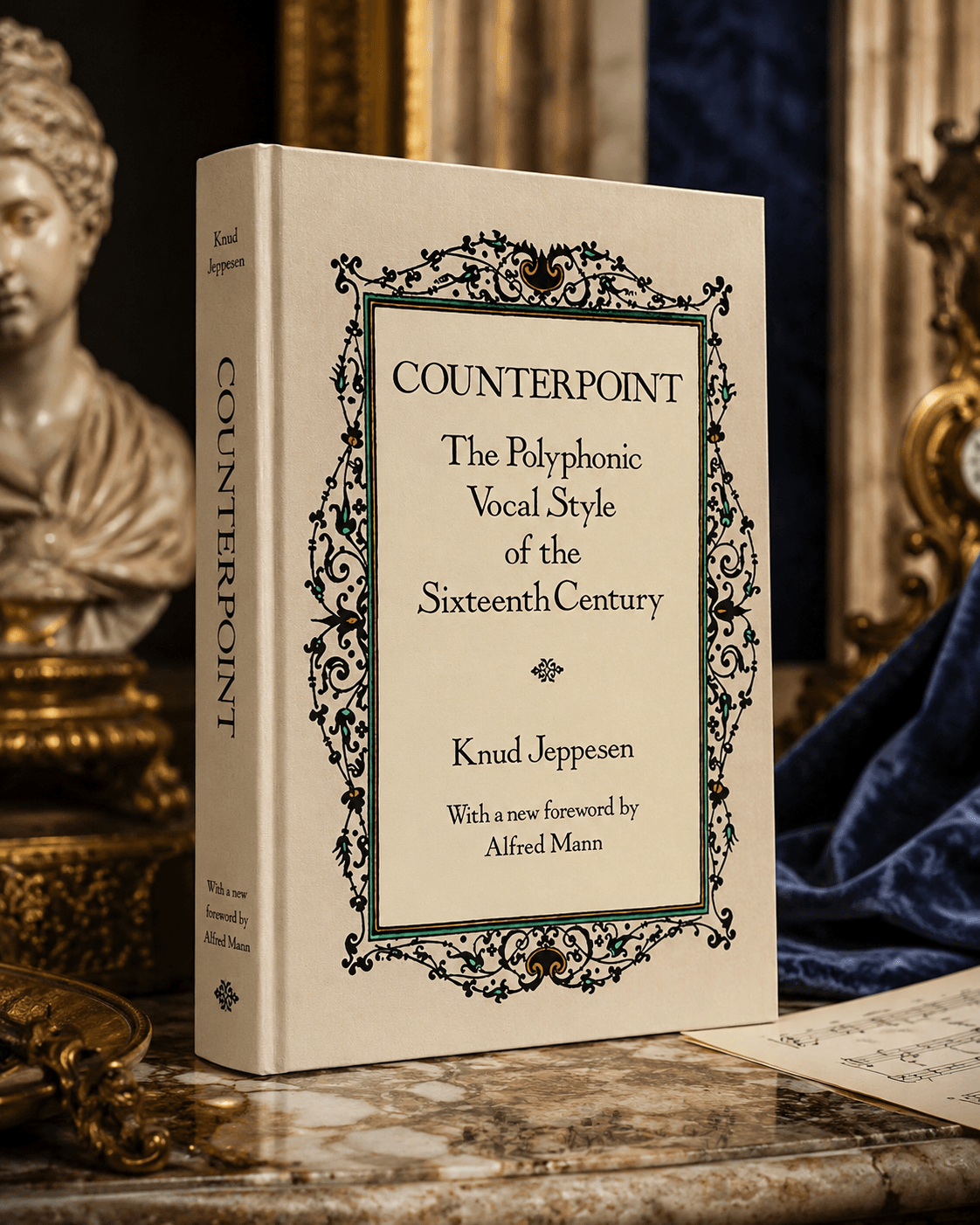
Book Description
Counterpoint: The Polyphonic Vocal Style of the Sixteenth Century by Knud Jeppesen is one of the classic textbooks on Renaissance counterpoint, Palestrina style, modal counterpoint, species writing, canon, motet, and Mass. The book balances historical explanation with practical exercises, showing how sixteenth century vocal polyphony works through melody, harmony, notation, modes, and carefully controlled voice leading. It is especially valuable for students, composers, teachers, theorists, and performers who want to understand counterpoint as a disciplined craft rather than a list of abstract rules.
Who this book is for?
This book is ideal if you want to:
Study Palestrina style with real depth.
Learn species counterpoint systematically.
Understand modal counterpoint historically.
Practice canon, motet, and Mass writing.
Strengthen Renaissance composition skills.
What will you learn?
In Counterpoint, you will learn how sixteenth century vocal polyphony is built from independent melodic lines that still form a coherent musical whole.
The book teaches the essential grammar of modal counterpoint, including consonance, dissonance, melodic motion, rhythmic control, cadences, and the relationship between horizontal line and vertical sonority. It is practical, but not shallow. Jeppesen wants the student to understand not only what is allowed, but why the style behaves as it does.
You will also learn how Palestrina style became a central model for later counterpoint pedagogy. Jeppesen studies the style as a living musical language, where each rule points toward balance, singability, clarity, and expressive restraint.
Book Overview
This review of Counterpoint: The Polyphonic Vocal Style of the Sixteenth Century can be summarized simply: it is one of the most important modern textbooks for anyone serious about Renaissance counterpoint.
The Dover edition was published in paperback on March 27, 1992, with ISBN 9780486270364. Dover’s own product page confirms the ISBN and publication date, while other listings identify the book as part of the Dover music catalogue.
As a summary, the book is divided into two broad areas. The first part gives an outline history of contrapuntal theory, moving from early medieval beginnings through later developments, with attention to Palestrina, Bach, the Palestrina movement after Fux, notation, ecclesiastical modes, melody, and harmony. The second part turns to practical counterpoint, including species in two, three, four, and more than four parts, as well as canon, motet, and Mass.
Is it worth it? Yes, especially if you want a counterpoint book that is both historical and practical. Some manuals give only rules. Others give only history. Jeppesen gives both, which is why the book still feels useful for serious students, even when newer textbooks offer more modern layouts or classroom pacing.
Topics Covered
Historical development of contrapuntal theory across centuries.
Core principles of Palestrina style and vocal balance.
Practical training in species counterpoint at several levels.
Discussion of ecclesiastical modes, melody, and harmony.
Exercises in two part, three part, and four part writing.
Advanced work on canon, motet, and Mass technique.
A bridge between music theory, analysis, and composition.
About the Author
Knud Jeppesen was a Danish musicologist and composer, born in 1892 and died in 1974. He is strongly associated with the study of Palestrina, Renaissance polyphony, and the theory of vocal counterpoint.
Jeppesen’s reputation rests especially on two major works: The Style of Palestrina and the Dissonance and Counterpoint: The Polyphonic Vocal Style of the Sixteenth Century. Together, these books helped shape modern understanding of sixteenth century counterpoint and Palestrina’s musical language.
What makes Jeppesen important is his combination of scholarship and pedagogy. He does not treat counterpoint as a dry school exercise. He connects it with historical sources, musical examples, stylistic analysis, and the practical discipline of writing singable polyphonic lines.
Why this book is worth it
Counterpoint is worth it because it remains one of the clearest bridges between Renaissance music theory and practical composition.
For composers, the book offers training in line, dissonance control, cadence, imitation, and modal organization. These skills matter even outside Renaissance style because they build the ability to think horizontally, not only harmonically.
For students, Jeppesen gives a disciplined path into species counterpoint without disconnecting it from real music. The exercises are not just puzzles. They are steps toward understanding how vocal polyphony breathes.
For teachers, the book is useful because it balances method and context. It can support a classroom focused on modal counterpoint, but it also gives enough historical background to prevent the subject from becoming a mechanical rule system.
For readers of Musicus Practicus, this book belongs beside partimento, harmony, counterpoint, and historical composition methods. It teaches the same essential lesson: theory becomes powerful when it becomes a practical art.
Buy this Book on Amazon
You can buy Counterpoint: The Polyphonic Vocal Style of the Sixteenth Century by Knud Jeppesen on Amazon. If you study Renaissance counterpoint, Palestrina style, modal counterpoint, species writing, canon, motet, or historical composition, this is a foundational book to consider.
It is especially recommended if you want a serious counterpoint manual that combines historical insight with practical exercises and musical examples.
FAQ on this Book
Does the book teach species counterpoint?
Yes. It teaches species counterpoint in two, three, four, and more than four parts, with exercises, solutions, and musical examples.
Is this book only about Palestrina?
No. Palestrina style is central, but the book also discusses contrapuntal history, notation, ecclesiastical modes, melody, harmony, canon, motet, and Mass.
How is this book different from Fux?
Fux is often more schematic and pedagogical. Jeppesen is more historically grounded and more directly focused on the polyphonic vocal style of the sixteenth century.
Continue Your Journey as a Musicus Practicus
If you desire to stop looking at early music from the outside and wish to step inside the musical mind of the 15th and 16th centuries, there are three distinct ways we can work together to elevate your skills:
- 1-to-1 Musical Apprenticeship: For a personalized, tailor-made path, book private lessons with me. We will work directly on your specific goals, from counterpoint to improvisation, Renaissance and Baroque composition, theory and practice, exactly as a master and apprentice would have done centuries ago.
- Patreon Support & Exclusive Content: Join our growing community of true Musici Prattici on Patreon!
Gain access to exclusive insights, behind-the-scenes materials, and support the ongoing creation of these deep-dive musical analyses.- The Musicus Practicus Academy (MPA): Enroll in my comprehensive on-demand courses.
Start with the free levels, and master the art of Renaissance and Baroque music step-by-step at your own pace.



All Rights Reserved - Richardus Cochlearius 2026