From Modes to Keys in Early Modern Music Theory
From Modes to Keys in Early Modern Music Theory
A valuable resource for readers interested in modal theory, keyboard practice, church tones, tonal space, basso continuo, and the historical birth of tonality.
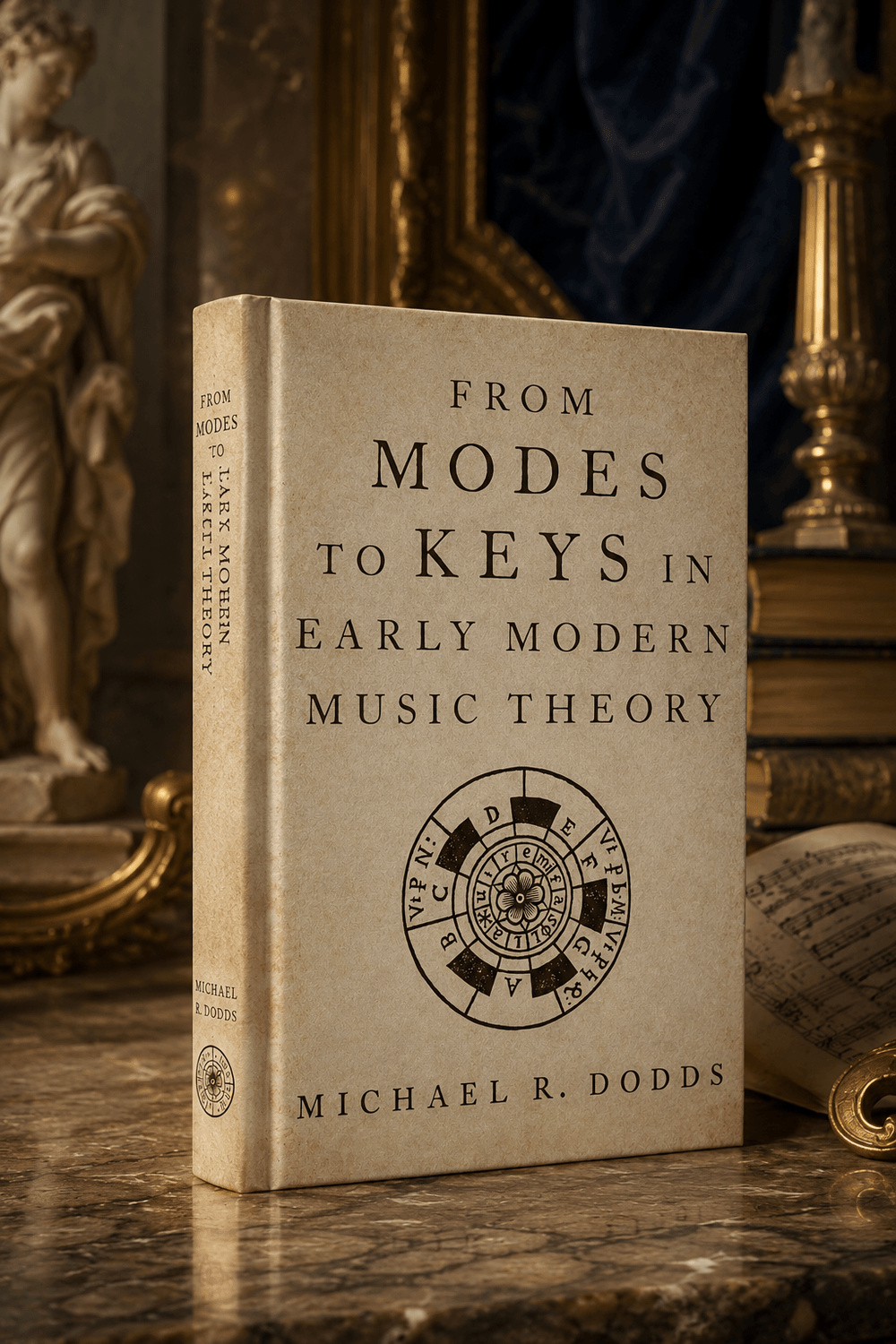
Book Description
From Modes to Keys in Early Modern Music Theory by Michael R. Dodds is a deep and ambitious study of the long transition from Renaissance modes to major minor tonality.
The book examines how theorists understood mode, key, tonal space, cadence, imitation, keyboard practice, church tones, and the circle of fifths between the sixteenth and eighteenth centuries. It is especially valuable for advanced students, theorists, composers, and historically informed performers who want to understand how the tonal system emerged from older modal ways of thinking.
Who this book is for?
This book is ideal if you want to:
Understand Renaissance modes historically.
Study the rise of major minor tonality.
Connect modal theory with keyboard practice.
Explore church tones and tonal space.
Deepen historical composition knowledge.
What will you learn?
In From Modes to Keys in Early Modern Music Theory, you will learn how European musicians gradually moved from older ways of thinking about mode toward the later world of keys, tonality, and the circle of fifths.
The book explains that this was not a simple switch, as if someone turned off Dorian mode on Friday and turned on D minor on Monday. Dodds presents the change as a layered historical process involving medieval chant theory, Renaissance polyphony, Baroque keyboard practice, and the changing organization of tonal space.
You will also learn why the keyboard matters so much. According to the summary published by Yale’s Institute of Sacred Music, early Baroque keyboard thinking helped shift the background pitch system from the diatonic gamut to the chromatic keyboard, and from ladder like tonal models toward circular models that culminated in the circle of fifths.
Book Overview
This review of From Modes to Keys in Early Modern Music Theory can be summarized clearly: it is one of the most important recent books for understanding the historical bridge between modal theory and tonal theory.
Dodds addresses a large and difficult question: how did European music theory move from the modal universe of Glarean’s Dodecachordon to the key based world represented by Bach’s Well Tempered Clavier? Yale’s description frames the contrast neatly: Glarean’s system involved twelve modes at two transposition levels, while Bach’s 1722 ordering used two modes at twelve transposition levels.
As a summary, the book spans two centuries of music theory and uses historical treatises, diagrams, and conceptual models to explain the shift from Renaissance modal systems to the major and minor keys. It is not just a catalogue of old theories. It is an attempt to explain how different musical worlds overlapped, competed, and slowly reorganized themselves.
Is it worth it? Yes, if you are serious about historical theory. This is not a light beginner book, but it is extremely valuable if you want to understand why seventeenth century music can feel both modal and tonal at the same time. That strange in between zone is exactly where the book shines.
Topics Covered
The transition from Renaissance modes to Baroque keys.
Historical models of modal theory and classification.
The role of cadential hierarchy in polyphonic mode.
Links between contrapuntal imitation and modality.
The growth of keyboard thinking in tonal space.
The emergence of church tones and basso continuo logic.
The path toward major minor tonality and the circle of fifths.
About the Author
Michael R. Dodds is Professor of Music History at the University of North Carolina School of the Arts. His research focuses on the history of music theory, post Tridentine liturgical practice, musical iconography, tonal space, and the relationship between music theory and the history of science.
His background makes him especially well suited to this topic. Dodds is not only asking a narrow theoretical question. He is connecting music theory, liturgical practice, keyboard culture, modal thought, and historical analysis into one large picture.
His UNCSA profile notes that From Modes to Keys in Early Modern Music Theory proposes a model for change in modal theory between the sixteenth and eighteenth centuries, while a related book, The Organ in Baroque Office Liturgy, considers the transition from modes to keys in musical practice.
Why this book is worth it
From Modes to Keys in Early Modern Music Theory is worth it because it gives historical depth to a question many musicians feel but cannot easily explain: when did modes become keys?
For composers, the book is valuable because it shows that tonality did not fall from the sky already complete. It grew from older systems of mode, cadence, polyphony, keyboard layout, and practical musical habits. That makes it especially useful for anyone composing in historical styles.
For theorists and analysts, Dodds offers a richer way to hear early modern music. Instead of forcing every piece into either “modal” or “tonal,” the book helps you understand mixed systems, transitional categories, and overlapping ways of organizing pitch.
For readers of Musicus Practicus, this book fits beautifully beside partimento, counterpoint, harmony, and historical composition methods. It explains the conceptual landscape that eventually made eighteenth century harmonic practice possible.
Buy this Book on Amazon
You can buy From Modes to Keys in Early Modern Music Theory by Michael R. Dodds on Amazon. If you study early modern music theory, Renaissance modes, Baroque tonality, counterpoint, or historical composition, this is a serious and valuable addition to your library.
FAQ on this Book
What historical problem does From Modes to Keys explain?
From Modes to Keys explains the transition from Renaissance modal theory to the later system of major and minor keys.
Why does Bach appear in a book about modes?
Bach’s Well Tempered Clavier represents a later world organized around major and minor keys at all transposition levels, making it a useful endpoint for the story.
How does this book connect to harmony study?
It shows how later harmony and tonality emerged from earlier systems of mode, cadence, keyboard layout, and contrapuntal organization.
Continue Your Journey as a Musicus Practicus
If you desire to stop looking at early music from the outside and wish to step inside the musical mind of the 15th and 16th centuries, there are three distinct ways we can work together to elevate your skills:
- 1-to-1 Musical Apprenticeship: For a personalized, tailor-made path, book private lessons with me. We will work directly on your specific goals, from counterpoint to improvisation, Renaissance and Baroque composition, theory and practice, exactly as a master and apprentice would have done centuries ago.
- Patreon Support & Exclusive Content: Join our growing community of true Musici Prattici on Patreon!
Gain access to exclusive insights, behind-the-scenes materials, and support the ongoing creation of these deep-dive musical analyses.- The Musicus Practicus Academy (MPA): Enroll in my comprehensive on-demand courses.
Start with the free levels, and master the art of Renaissance and Baroque music step-by-step at your own pace.



All Rights Reserved - Richardus Cochlearius 2026