Getting Started with Species Counterpoint
Getting Started with Species Counterpoint
Stop guessing which notes work together and start mastering the art of polyphony. This book provides the logical foundation you need to elevate your harmonic and melodic understanding.
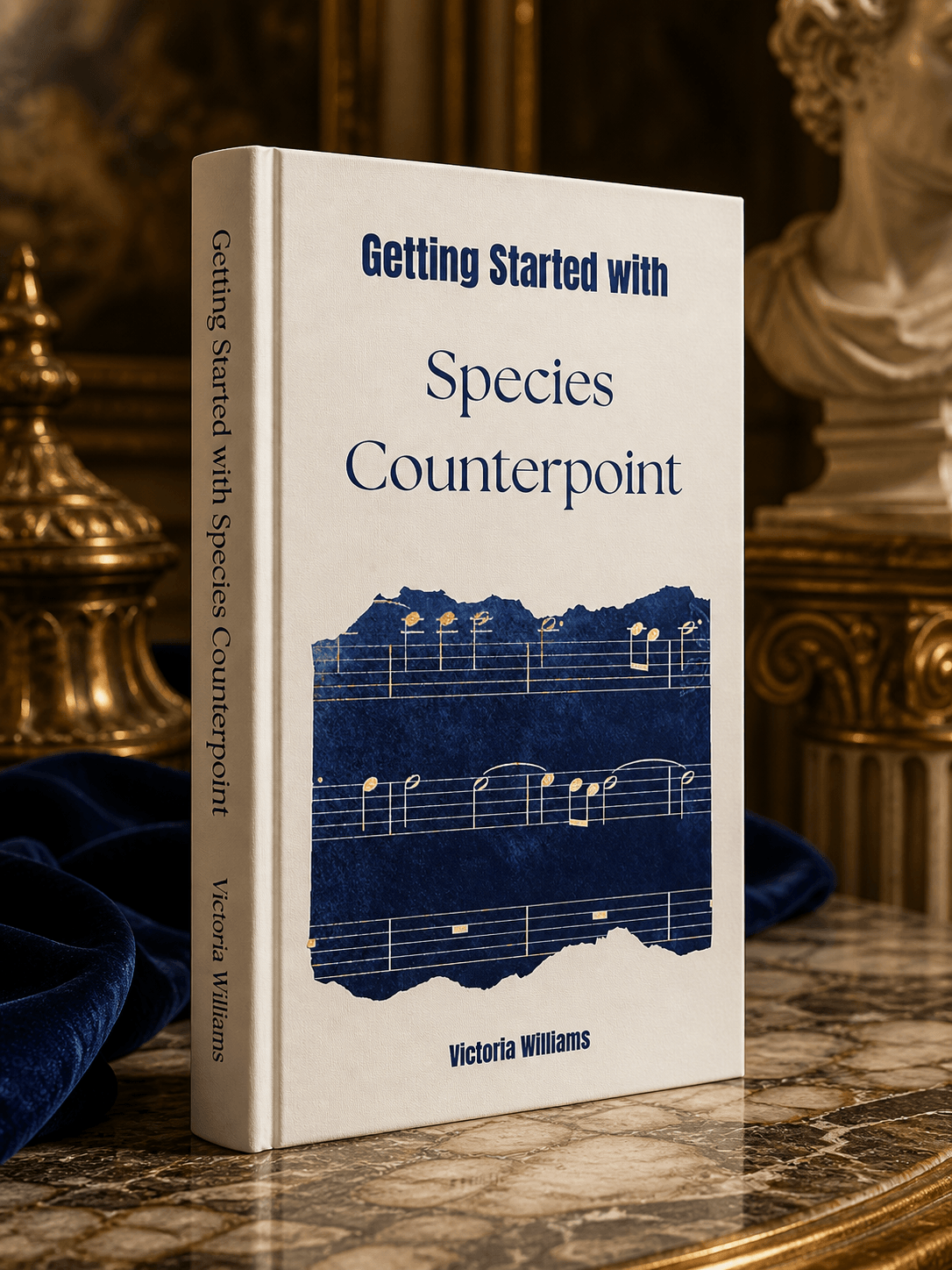
Book Description
Getting Started with Species Counterpoint by Victoria Williams is a practical, user-friendly manual designed to demystify the rigorous world of strict counterpoint. By focusing on the foundational two-voice textures, Williams provides a clear path through the five traditional species. This book removes the academic jargon often found in older treatises, making the art of composition accessible to self-taught students and undergraduates seeking a reliable species counterpoint review.
Who this book is for?
This book is ideal if you want to:
Master the fundamental laws of voice leading without feeling overwhelmed by complex terminology.
Develop a strong foundation in polyphonic writing before moving on to advanced fugue or orchestration.
Find a clear and structured workbook approach to the traditional Gradus ad Parnassum methodology.
What will you learn?
You will gain the ability to write elegant melodies against a cantus firmus while adhering to historical constraints. The text teaches you how to manage consonance and dissonance effectively across different rhythmic subdivisions. By the end, you will understand how to combine independent lines into a cohesive musical whole.
Book Overview
Victoria Williams focuses on the pedagogical clarity required for beginners. The book moves systematically from Note against Note (First Species) through to Florid Counterpoint (Fifth Species). It emphasizes the practical application of rules rather than just theoretical memorization. This makes it an excellent introductory resource for anyone curious about the historical roots of Western harmony.
Topics Covered
The essential rules of melodic motion including how to handle leaps and stepwise movement in a single voice.
Guidelines for creating perfect and imperfect consonances to ensure a balanced and pleasing harmonic sonority between parts.
Detailed instructions for Second Species counterpoint focusing on two notes against one and the proper use of passing tones.
Techniques for Third Species counterpoint which introduces four notes against one and the concept of the changing note or nota cambiata.
The mastery of Fourth Species syncopation where suspensions create tension and relaxation through tied notes and rhythmic displacement.
A comprehensive look at Fifth Species or Florid counterpoint which combines all previous rhythmic elements into a free flowing musical line.
About the Author
Victoria Williams is a respected music educator and the founder of the Music Theory Academy. She specializes in making complex theory topics understandable for students worldwide. Her expertise in the ABRSM syllabus and historical composition methods ensures that her teaching is both accurate and highly effective for exam preparation
Why this book is worth it
In a world of dense academic texts, this book stands out because it is genuinely accessible. It is worth it for the clarity of its examples and the logical progression of its exercises. If you want a no-nonsense guide that delivers immediate results in your composing skills, this is the investment to make.
Buy this Book on Amazon
You can check the book and its current availability here:
FAQ on this Book
Does this book cover more than two voices?
No, this volume focuses specifically on two-part counterpoint to ensure the beginner has a rock-solid foundation before adding more complexity.
Can I use this for self-study?
Absolutely. The clear explanations and numerous musical examples make it one of the best resources for independent learners.
Is this book based on the Fux method?
Yes, it follows the traditional species approach popularized by Johann Joseph Fux, which has been the standard for centuries.
Continue Your Journey as a Musicus Practicus
If you desire to stop looking at early music from the outside and wish to step inside the musical mind of the 15th and 16th centuries, there are three distinct ways we can work together to elevate your skills:
- 1-to-1 Musical Apprenticeship: For a personalized, tailor-made path, book private lessons with me. We will work directly on your specific goals, from counterpoint to improvisation, Renaissance and Baroque composition, theory and practice, exactly as a master and apprentice would have done centuries ago.
- Patreon Support & Exclusive Content: Join our growing community of true Musici Prattici on Patreon!
Gain access to exclusive insights, behind-the-scenes materials, and support the ongoing creation of these deep-dive musical analyses.- The Musicus Practicus Academy (MPA): Enroll in my comprehensive on-demand courses.
Start with the free levels, and master the art of Renaissance and Baroque music step-by-step at your own pace.


All Rights Reserved - Richardus Cochlearius 2026