I Modi della polifonia vocale classica descritti secondo le fonti
I Modi della polifonia vocale classica descritti secondo le fonti
What is I Modi della polifonia vocale classica by Bernhard Meier about? It is a source based guide to modal thinking in sixteenth century polyphony
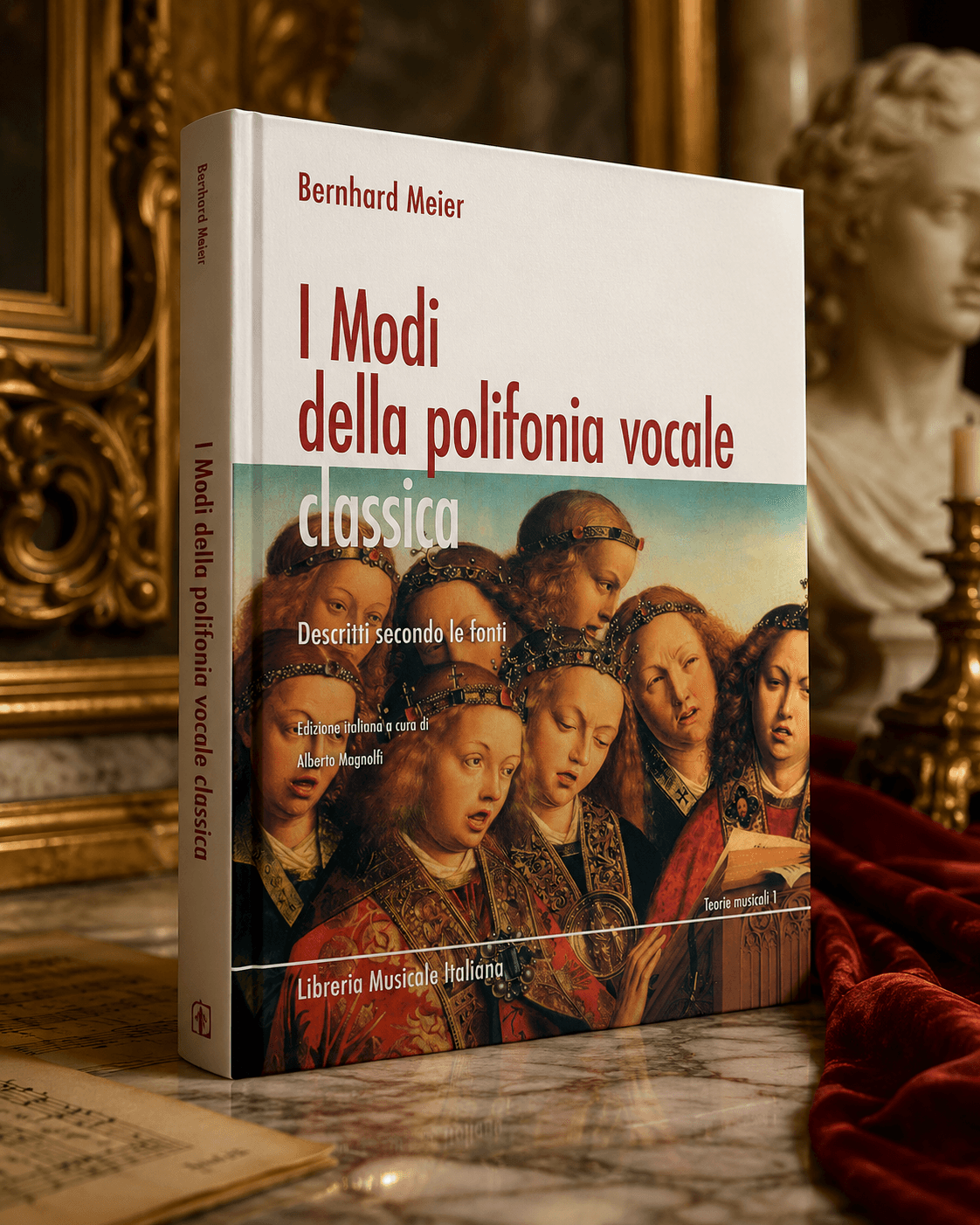
Book Description
I Modi della polifonia vocale classica by Bernhard Meier is a major study of Renaissance modes, vocal polyphony, sixteenth century theory, and historical sources. It explains how composers and theorists understood modal organization before later tonal habits changed the way musicians read older music.
Who this book is for?
This book is ideal if you want to:
Understand Renaissance modes through historical sources.
Study Palestrina, Lassus, Rore, and sacred polyphony.
Move beyond modern major minor thinking.
Learn how finals, ambitus, and cadences shape the modes.
Strengthen your counterpoint, analysis, and Renaissance composition skills.
What will you learn?
In I Modi della polifonia vocale classica, you will learn how sixteenth century musicians, theorists, composers, and choir masters understood the modes in real polyphonic music.
The book helps you see why a mode is not just a scale. In Renaissance polyphony, a mode also involves range, final, reciting tones, cadences, and the way voices behave together.
You will also learn how historical theory can correct modern habits. Instead of forcing Palestrina, Rore, Lassus, and classical vocal polyphony into later tonal categories, Meier asks us to listen through the ears of the period.
Book Overview
This review of I Modi della polifonia vocale classica can be summarized simply: it is not a light beach read, unless your beach bag usually contains Zarlino, Glarean, and a pencil for marking cadences.
The Italian edition was published by LIM in 2015, edited by Alberto Magnolfi, and belongs to the Teorie Musicali series. The publisher lists the volume as 17 by 24 cm, XLVI plus 584 pages, with ISBN 9788870968187.
The original German study, Die Tonarten der klassischen Vokalpolyphonie, was published in 1974, and an English translation appeared in 1988 as The Modes of Classical Vocal Polyphony.
Meier’s central idea is beautifully old fashioned in the best sense: understand Renaissance music, modal theory, polyphonic practice, and historical sources before translating everything into modern theory.
Topics Covered
A source based explanation of how Renaissance modes work in sixteenth century vocal polyphony.
A detailed study of finals, ambitus, cadences, and modal classification.
Historical context for Renaissance sacred music, secular music, and modal theory.
Practical insight into how modal analysis changes our hearing of Palestrina style counterpoint.
A clear distinction between later tonal habits and Renaissance modal thinking.
A useful framework for analyzing motets, masses, madrigals, and polyphonic works.
A bridge between musicology, counterpoint, historical theory, and composition practice.
About the Author
Bernhard Meier was a German musicologist, Renaissance scholar, editor, and university teacher. He is especially associated with research on modal theory, Renaissance polyphony, and composers such as Cipriano de Rore. Sources identify him as born in 1923 and died in 1993.
His work matters because he did not treat old theory as decorative background. For Meier, historical sources, modal categories, polyphonic repertory, and musical analysis belong together.
The Italian edition was curated by Alberto Magnolfi, whose profile notes that in 2015 he prepared the Italian edition with preface, critical apparatus, bibliography, and indexes.
Why this book is worth it
I Modi della polifonia vocale classica is worth it if you want a serious modal theory book, a reliable Renaissance polyphony guide, and a historically grounded counterpoint resource.
For composers, the value is practical.
Once you understand mode, cadence, voice range, and final, Renaissance polyphony stops looking like a cloud of beautiful notes and starts looking like an organized musical language.
For analysts, the book gives you better tools.
A motet is not simply “in D minor before D minor existed.” It may be living in a modal universe with its own grammar, manners, and elegant old rules.
For readers of Musicus Practicus, this book fits naturally beside counterpoint, partimento, harmony, and historical composition methods. It trains the same habit of mind: do not only label music, learn how it thinks.
Buy this Book on Amazon
You can buy I Modi della polifonia vocale classica by Bernhard Meier on Amazon. It is especially recommended if you study Renaissance counterpoint, modal theory, vocal polyphony, or historical composition.
FAQ on this Book
What is the book about?
The book explains the modes of classical vocal polyphony according to sixteenth century sources, focusing on how historical musicians understood modal organization in real polyphonic music.
Is this book useful for composers?
Yes. It is useful for composers who want to understand modal composition, Renaissance counterpoint, cadential structure, and historical musical grammar.
Is this book only for musicologists?
No. Although it is scholarly, it is also valuable for composers, theory teachers, conductors, early music performers, and serious students of historical composition methods.
Continue Your Journey as a Musicus Practicus
If you desire to stop looking at early music from the outside and wish to step inside the musical mind of the 15th and 16th centuries, there are three distinct ways we can work together to elevate your skills:
- 1-to-1 Musical Apprenticeship: For a personalized, tailor-made path, book private lessons with me. We will work directly on your specific goals, from counterpoint to improvisation, Renaissance and Baroque composition, theory and practice, exactly as a master and apprentice would have done centuries ago.
- Patreon Support & Exclusive Content: Join our growing community of true Musici Prattici on Patreon!
Gain access to exclusive insights, behind-the-scenes materials, and support the ongoing creation of these deep-dive musical analyses.- The Musicus Practicus Academy (MPA): Enroll in my comprehensive on-demand courses.
Start with the free levels, and master the art of Renaissance and Baroque music step-by-step at your own pace.



All Rights Reserved - Richardus Cochlearius 2026