Joseph Riepel’s Theory of Metric and Tonal Order: Phrase and Form
Joseph Riepel's Theory of Metric and Tonal Order - Phrase and Form (Harmonologia)
A scholarly translation and commentary on Joseph Riepel’s theory of phrase, form, tonal order, metric design, and eighteenth century instrumental composition.
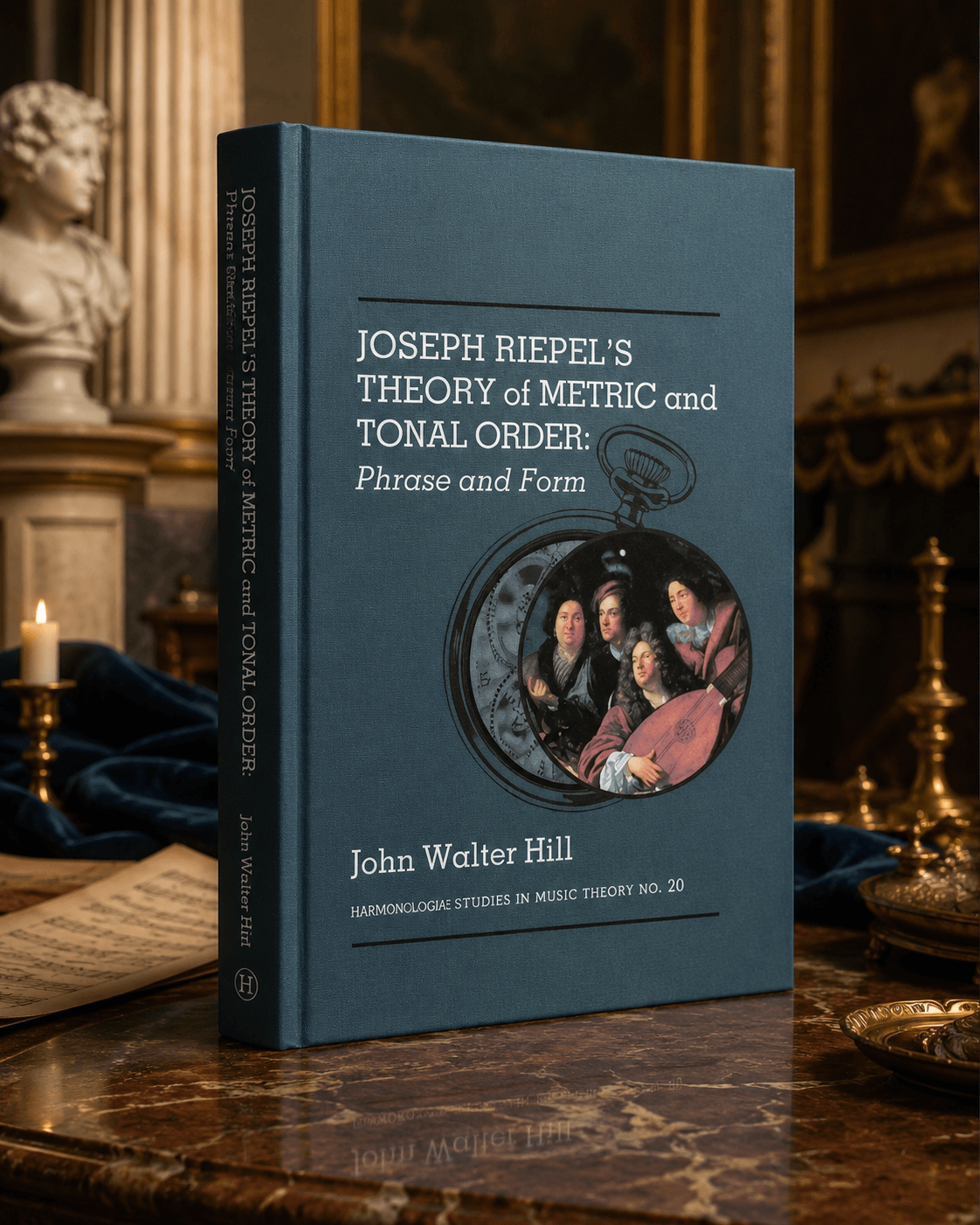
Book Description
Joseph Riepel’s Theory of Metric and Tonal Order by John Walter Hill is a major English translation and commentary on Riepel’s early theory of phrase structure, tonal order, metric design, galant form, and eighteenth century composition. The book presents the first two chapters of Riepel’s Anfangsgründe zur musicalischen Setzkunst, offering modern readers access to one of the most influential early theories of instrumental form. It is especially useful for theorists, composers, performers, and analysts interested in how symphonies, concertos, and sonatas were understood before later textbook categories became standard.
Who this book is for?
This book is ideal if you want to:
Study galant phrase structure in depth.
Understand Riepel’s theory of form.
Explore eighteenth century composition.
Connect cadence with phrase order.
Analyze sonata, symphony, and concerto style.
What will you learn?
In Joseph Riepel’s Theory of Metric and Tonal Order, you will learn how Riepel thought about phrase, period, closure, tonal motion, and large scale instrumental design.
The book is important because Riepel was not simply listing rules. He was trying to explain how musical ideas become intelligible over time. His theory connects metric order, tonal planning, cadential closure, and phrase hierarchy into a practical grammar of eighteenth century composition.
You will also learn why this matters for later theory. The book description notes that Riepel’s first two volumes contain a substantially complete presentation of an early and influential compositional and analytical theory related to the major homophonic instrumental forms of the eighteenth century, including symphony, concerto, and sonata.
Book Overview
This review of Joseph Riepel’s Theory of Metric and Tonal Order can be summarized clearly: it is not just a translation of an old treatise. It is a guided entrance into a different way of thinking about musical form.
The volume translates and comments on the first two chapters of Riepel’s Anfangsgründe zur musicalischen Setzkunst, originally published in 1752 and 1755. The book appeared with Pendragon Press in the Harmonologia series, and library records list it as xxii plus 471 pages, with musical examples and scholarly apparatus.
As a summary, the book deals with the musical logic behind phrases, formal segments, tonal destinations, repetition, contrast, and closure. In Riepel’s world, form is not a rigid diagram imposed from above. It is something built from musical gestures that imply, continue, answer, and conclude.
Is it worth it? Yes, especially if you are interested in Classical form before Classical form became a classroom label. Riepel’s theory helps explain the musical thinking behind the eighteenth century style from the inside. It is like being handed the workshop notes of a composer who cares deeply about balance, proportion, and the moment when a phrase finally knows where it is going.
Topics Covered
Translation of Riepel’s treatise on phrase and tonal order.
Commentary on metric design and phrase hierarchy.
Study of cadence, closure, and formal articulation.
Analysis of galant style and instrumental composition.
Insight into symphony, concerto, and sonata thinking.
Connections with Leopold Mozart, Koch, and later theory.
A bridge between music theory, analysis, and composition.
About the Author
John Walter Hill is an American musicologist known for work on Baroque music, early modern music, and historically grounded music theory. Library and publisher records identify him as the translator and commentator of this Riepel volume.
Hill’s wider scholarship includes Baroque Music: Music in Western Europe, 1580 to 1750, and his academic work has engaged deeply with early music, performance, and historical theory. His curriculum vitae lists Joseph Riepel’s Theory of Metric and Tonal Order, Phrase and Form among his major book publications.
This background matters because Riepel is not easy to translate mechanically. His treatise uses dialogue, examples, technical terms, and eighteenth century assumptions that need careful explanation. Hill’s commentary helps modern readers understand the theory without flattening its historical character.
Why this book is worth it
Joseph Riepel’s Theory of Metric and Tonal Order is worth it because it opens a crucial window onto eighteenth century musical thinking. Many musicians learn Classical form through later labels such as exposition, development, recapitulation, period, sentence, and cadence. Riepel shows an earlier layer of thinking, closer to the living formation of the style.
For composers, the book is valuable because it shows how musical form can grow from phrase balance, metric implication, cadential closure, and tonal direction. This is practical knowledge. It helps you write music that moves, breathes, and concludes with clarity.
For theorists and analysts, the book is a serious tool for understanding galant composition, early Classical syntax, and the historical background of later theories by writers such as Heinrich Christoph Koch. Riepel’s ideas were influential, and Hill’s commentary helps place them in a broader intellectual and musical context.
For readers of Musicus Practicus, this book fits naturally beside partimento, counterpoint, harmony, and historical composition methods. It reminds us that form is not only architecture. It is grammar, rhythm, expectation, and tonal speech.
Buy this Book on Amazon
You can buy Joseph Riepel’s Theory of Metric and Tonal Order: Phrase and Form by John Walter Hill on Amazon. If you study eighteenth century music theory, galant style, phrase structure, sonata form, or historical composition, this is a serious book to consider for your library.
FAQ on this Book
What does Riepel mean by metric and tonal order?
In this context, metric and tonal order refers to how phrases are organized through measure grouping, closure, cadence, tonal direction, and musical expectation.
Why is this book important for galant style?
It is important because Riepel gives one of the clearest early accounts of galant phrase structure, formal balance, repetition, contrast, and tonal planning.
Is this book mainly a translation or a commentary?
It is both. Hill provides an English translation of Riepel’s first two chapters and extensive commentary to clarify terminology, context, examples, and historical importance.
Continue Your Journey as a Musicus Practicus
If you desire to stop looking at early music from the outside and wish to step inside the musical mind of the 15th and 16th centuries, there are three distinct ways we can work together to elevate your skills:
- 1-to-1 Musical Apprenticeship: For a personalized, tailor-made path, book private lessons with me. We will work directly on your specific goals, from counterpoint to improvisation, Renaissance and Baroque composition, theory and practice, exactly as a master and apprentice would have done centuries ago.
- Patreon Support & Exclusive Content: Join our growing community of true Musici Prattici on Patreon!
Gain access to exclusive insights, behind-the-scenes materials, and support the ongoing creation of these deep-dive musical analyses.- The Musicus Practicus Academy (MPA): Enroll in my comprehensive on-demand courses.
Start with the free levels, and master the art of Renaissance and Baroque music step-by-step at your own pace.




All Rights Reserved - Richardus Cochlearius 2026