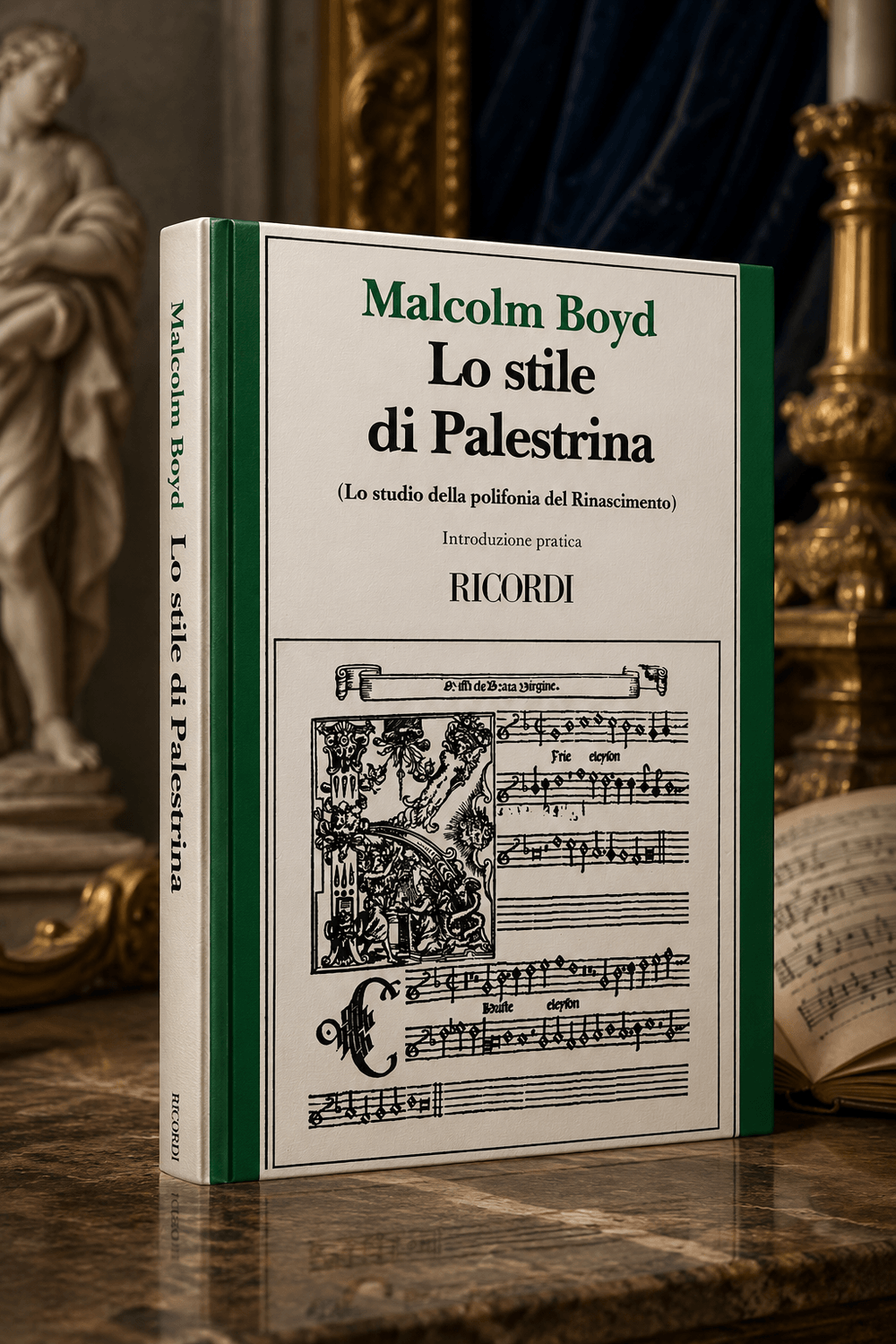
Lo stile di Palestrina. Lo studio della polifonia del Rinascimento. Introduzione pratica
Lo stile di Palestrina. Lo studio della polifonia del Rinascimento Boyd Italiano
A focused resource for students, teachers, composers, and choir directors who want to understand the sound and craft of sixteenth century counterpoint.
Book Description
Lo stile di Palestrina by Malcolm Boyd is a compact and practical guide to Palestrina style, Renaissance vocal polyphony, sixteenth century counterpoint, harmony, and cadence. Using the music of Giovanni Pierluigi da Palestrina as its foundation, the book introduces the main stylistic features of motets and masses through clear explanations, musical examples, and graded exercises. It is especially useful for students, teachers, composers, and choir directors who want to understand how Renaissance polyphony works in real musical practice, not only as historical theory.
Who this book is for?
This book is ideal if you want to:
Study Palestrina style without getting lost.
Understand Renaissance polyphony through examples.
Improve vocal counterpoint step by step.
Learn how cadences shape sacred music.
Practice motet and mass style writing.
What will you learn?
In Lo stile di Palestrina, you will learn how sixteenth century vocal music is shaped through melody, counterpoint, harmony, cadence, and texture.
The book helps you see why Palestrina’s music became a model for Renaissance polyphony. His style is not just “smooth counterpoint.” It is a disciplined way of balancing independent voices, controlling dissonance, shaping cadences, and giving sacred vocal music a calm but intensely organized flow.
You will also learn how to connect theory with writing. Since the original description emphasizes music examples and graded exercises, this is not only a book to read. It is a book to keep open while you test ideas, write lines, and discover how a Palestrina like texture actually behaves.
Book Overview
This review of Lo stile di Palestrina can be summarized simply: it is a short, focused, and practical doorway into one of the most important styles in Western counterpoint.
The Italian edition was published by Casa Ricordi in 1981, translated by Anna Maria Morazzoni, and listed with 48 pages and ISBN 9788875921309. The English original, Palestrina’s Style: A Practical Introduction, appeared with Oxford University Press in 1973.
As a summary, Boyd’s aim is clear: describe the essential stylistic features of sixteenth century vocal music through Palestrina’s works, especially the main forms of motet and mass. The book gives importance to contrapuntal texture, but also includes harmony and cadence, which are often the places where students either begin to understand the style or begin to panic quietly at the desk.
Is it worth it? Yes, especially if you want something more direct than a large historical treatise. This is not a massive encyclopedia of Renaissance music. It is closer to a clean, practical map. You still have to walk the terrain yourself, but at least you are not wandering through a forest of suspensions with no compass.
Topics Covered
Essential features of Palestrina style in vocal music.
Study of motet and mass as central Renaissance forms.
Clear work on contrapuntal texture and voice balance.
Attention to harmony, cadence, and tonal direction.
Musical examples from sixteenth century polyphony.
Graded exercises for practical counterpoint study.
A bridge between analysis, composition, and performance.
About the Author
Malcolm Boyd was a British musicologist and writer, widely known for his work on Bach, Domenico Scarlatti, and eighteenth century music. He taught at the University of Wales, Cardiff from 1973 to 1992 and died in 2001.
Although he is often remembered for his Bach scholarship, Lo stile di Palestrina shows another side of his teaching: the ability to explain a complex historical style with clarity and practical purpose.
That matters for this book. Boyd does not present Palestrina style as a sacred marble statue that students must admire from a distance. He treats it as a craft that can be studied, practiced, and gradually internalized through examples and exercises.
Why this book is worth it
Lo stile di Palestrina is worth it because it gives students a manageable entrance into Renaissance counterpoint. Many books on polyphony are either very technical or very historical. Boyd’s strength is that he keeps the focus on how the style actually works.
For composers, the book offers training in vocal line writing, dissonance control, cadential motion, and balanced polyphonic texture. These skills are useful far beyond Renaissance imitation. They sharpen the ear for musical direction.
For performers and choir directors, it gives a clearer sense of why Palestrina’s music breathes the way it does. Understanding motet structure, cadence, and contrapuntal flow can improve phrasing, rehearsal work, and musical interpretation.
For readers of Musicus Practicus, this book fits naturally beside counterpoint, partimento, harmony, and historical composition methods. It reminds us that practical theory is not a pile of labels. It is a way of hearing and making music.
Buy this Book on Amazon
You can buy Lo stile di Palestrina by Malcolm Boyd on Amazon. If you study Palestrina style, Renaissance polyphony, vocal counterpoint, motets, masses, or historical composition, this small book can be a very useful addition to your working library.
FAQ on this Book
Does the book help with motet and mass writing?
Yes. The book uses Palestrina’s music as the basis for understanding the main Renaissance vocal forms, especially motet and mass.
Does Lo stile di Palestrina include practical exercises?
Yes. Lo stile di Palestrina includes musical examples and graded exercises, making it useful for readers who want to practice Palestrina style, not only read about it.
Can this book help choir directors?
Yes. Choir directors can use it to better understand Renaissance vocal texture, phrasing, cadences, and the way Palestrina’s lines interact.
Continue Your Journey as a Musicus Practicus
If you desire to stop looking at early music from the outside and wish to step inside the musical mind of the 15th and 16th centuries, there are three distinct ways we can work together to elevate your skills:
- 1-to-1 Musical Apprenticeship: For a personalized, tailor-made path, book private lessons with me. We will work directly on your specific goals, from counterpoint to improvisation, Renaissance and Baroque composition, theory and practice, exactly as a master and apprentice would have done centuries ago.
- Patreon Support & Exclusive Content: Join our growing community of true Musici Prattici on Patreon!
Gain access to exclusive insights, behind-the-scenes materials, and support the ongoing creation of these deep-dive musical analyses.- The Musicus Practicus Academy (MPA): Enroll in my comprehensive on-demand courses.
Start with the free levels, and master the art of Renaissance and Baroque music step-by-step at your own pace.


All Rights Reserved - Richardus Cochlearius 2026