Mensuration and Proportion Signs: Origins and Evolution
Mensuration and Proportion Signs: Origins and Evolution
A serious resource for scholars, performers, editors, and advanced students who want to understand early music notation beyond modern transcription.
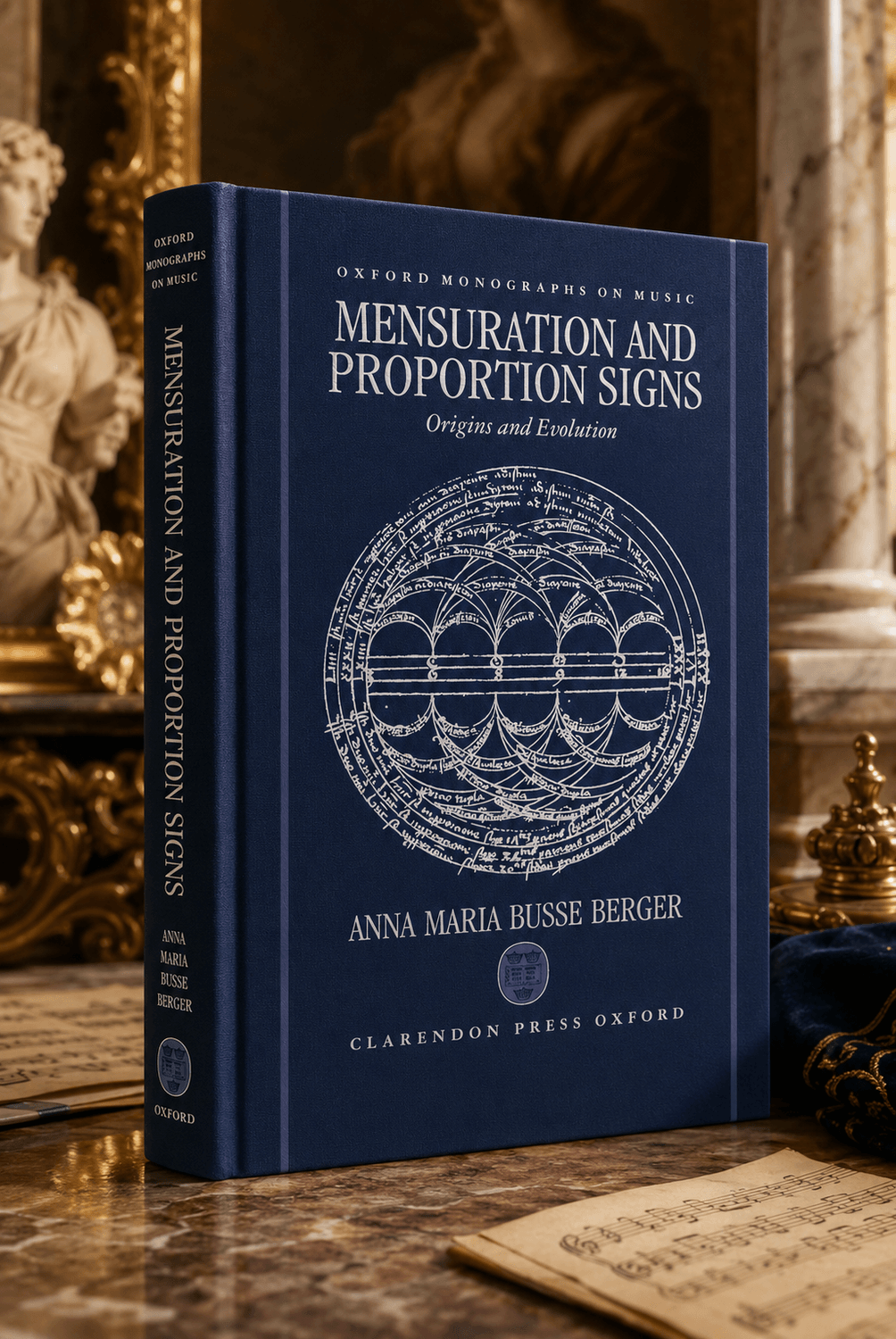
Book Description
Mensuration and Proportion Signs: Origins and Evolution by Anna Maria Busse Berger is a rigorous study of mensural notation, proportion signs, medieval music theory, Renaissance notation, rhythmic ratios, and the mathematical culture behind early musical time. The book investigates how signs used between the fourteenth and sixteenth centuries acquired their meanings, changed across theory and practice, and shaped the reading of polyphonic music. It is especially valuable for scholars, editors, performers, theorists, and advanced students who want to understand early notation from the inside.
Who this book is for?
This book is ideal if you want to:
Understand mensural notation in depth.
Study proportion signs historically.
Read Renaissance notation more accurately.
Connect music theory with mathematics.
Improve early music transcription skills.
What will you learn?
In Mensuration and Proportion Signs, you will learn how medieval and Renaissance musicians used signs to organize musical time, rhythm, and proportional relationships.
The book explains the meanings of mensuration signs, proportion signs, and related theoretical concepts from the fourteenth to the sixteenth century. Oxford’s description emphasizes that Berger analyzes the exact meaning of these signs in music and theory across this period, which makes the book especially useful for readers working directly with early notation.
You will also learn why these signs are not simple ancestors of modern time signatures. They belong to a world where music theory, arithmetic, ratio, tactus, and written practice were deeply connected. This is where the book becomes fascinating: a small circle, cut circle, number, or proportional sign can open an entire intellectual universe.
Book Overview
This review of Mensuration and Proportion Signs can be summarized clearly: it is a specialized but important book for anyone who wants to understand how medieval and Renaissance musicians measured musical time.
The book was published by Clarendon Press in 1993 as part of Oxford Monographs on Music. Google Books lists it as an illustrated reprint with 271 pages, ISBN 0198162308 and 9780198162308. Amazon lists the same ISBN and identifies the publisher as Clarendon Press, with 284 pages.
As a summary, the book studies the origin, interpretation, and development of signs that are often among the most confusing elements of early music notation. These signs are not decorative symbols. They tell the reader how to understand duration, proportion, perfection, imperfection, and the relationship between written values and musical time.
Is it worth it? Yes, if you work seriously with medieval or Renaissance sources. This is not a casual introduction to early music. It is a precise scholarly tool. But for the right reader, it is exactly the book that turns strange notational symbols from mysterious little moons into readable musical instructions.
Topics Covered
Historical meanings of mensuration signs in early music.
Evolution of proportion signs from theory to practice.
Connections between music notation and arithmetic.
Interpretation of rhythmic ratios in polyphonic sources.
Study of fourteenth century to sixteenth century theory.
Tools for better transcription and editorial judgment.
A bridge between musicology, notation, and performance.
About the Author
Anna Maria Busse Berger is Distinguished Professor of Music, emerita at the University of California, Davis. Her UC Davis profile lists her fields as Medieval and Renaissance history and theory, historiography, missionary music in Africa, notation, mensuration, proportion signs, music and memory, mathematics and music, and related areas.
Her profile also notes that Mensuration and Proportion Signs was her first book and describes it as the first fundamental study of time signatures in early music and their relationship to other measuring systems of the period and fifteenth century arithmetic.
This background matters because the book is not only about notation. Berger brings together music theory, mathematics, historical sources, and intellectual history. That combination is essential for understanding signs that were never merely practical marks, but part of a larger culture of measurement.
Why this book is worth it
Mensuration and Proportion Signs is worth it because it helps readers understand one of the most difficult areas of early music: how musicians before modern notation represented time.
For performers, the book can sharpen awareness of tactus, proportion, rhythm, and the problems hidden behind modern editions. A transcription may look simple, but the original signs often raise questions that affect tempo, grouping, and musical flow.
For editors and scholars, the book is valuable because it explains how signs behave across theory and practice. That matters when deciding how to interpret mensural notation, proportional relationships, or conflicting source evidence.
For composers and theorists, the book offers historical depth. It shows how musical time was once connected to ratio, number, and symbolic systems in ways that modern notation often hides. This can enrich the study of counterpoint, Renaissance polyphony, and historical composition.
For readers of Musicus Practicus, this book belongs beside partimento, counterpoint, modal theory, and early notation studies. It reminds us that historical music theory is not only about notes. It is also about how musicians measured, imagined, and organized musical time.
Buy this Book on Amazon
You can buy Mensuration and Proportion Signs: Origins and Evolution by Anna Maria Busse Berger on Amazon. If you study mensural notation, proportion signs, medieval theory, Renaissance notation, transcription, or early music performance, this is a serious reference to consider.
It is especially recommended if you want to move beyond modern editions and understand the notational logic that shaped medieval and Renaissance polyphony.
FAQ on this Book
Why are mensuration signs important?
Mensuration signs are important because they show how medieval and Renaissance musicians understood time, note values, perfection, imperfection, and rhythmic organization.
Are proportion signs the same as modern time signatures?
No. Proportion signs are related to measurement, but they work within a different theoretical world involving ratios, tactus, mensural values, and historical notation systems.
Does the book focus on the Middle Ages or the Renaissance?
It covers both. The book studies music and theory from the fourteenth to the sixteenth century, making it useful for late medieval and Renaissance repertories.
Continue Your Journey as a Musicus Practicus
If you desire to stop looking at early music from the outside and wish to step inside the musical mind of the 15th and 16th centuries, there are three distinct ways we can work together to elevate your skills:
- 1-to-1 Musical Apprenticeship: For a personalized, tailor-made path, book private lessons with me. We will work directly on your specific goals, from counterpoint to improvisation, Renaissance and Baroque composition, theory and practice, exactly as a master and apprentice would have done centuries ago.
- Patreon Support & Exclusive Content: Join our growing community of true Musici Prattici on Patreon!
Gain access to exclusive insights, behind-the-scenes materials, and support the ongoing creation of these deep-dive musical analyses.- The Musicus Practicus Academy (MPA): Enroll in my comprehensive on-demand courses.
Start with the free levels, and master the art of Renaissance and Baroque music step-by-step at your own pace.




All Rights Reserved - Richardus Cochlearius 2026