Modal Counterpoint: Renaissance Style
Modal Counterpoint: Renaissance Style
A valuable method for students, composers, and teachers who want to learn modal counterpoint through graded exercises and historical sources.
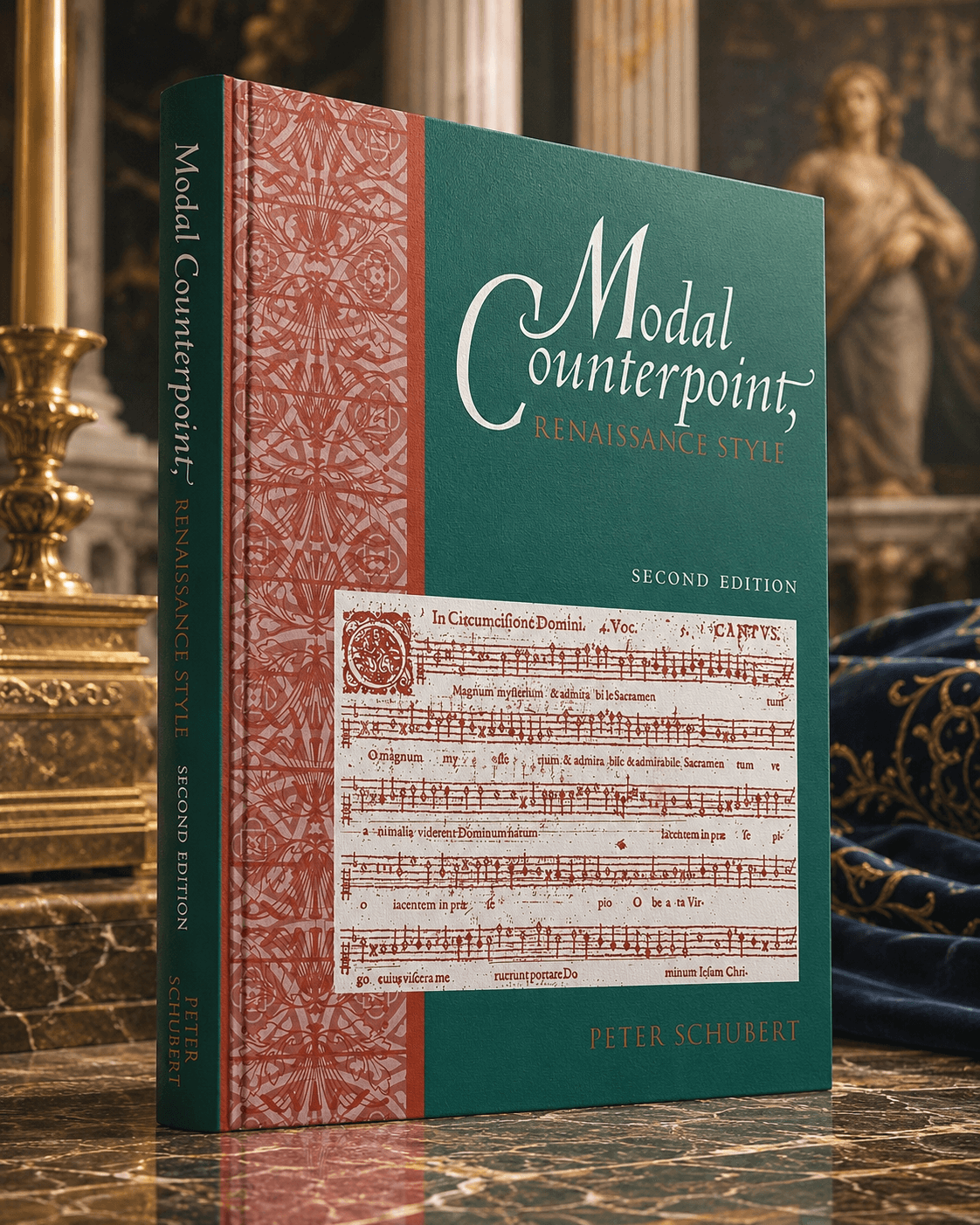
Book Description
Modal Counterpoint: Renaissance Style by Peter Schubert is a practical and source based textbook on Renaissance counterpoint, modal composition, sixteenth century music, species counterpoint, imitation, and voice leading. Published by Oxford University Press, the book guides students through carefully graded exercises for writing and analyzing Renaissance style polyphony. It is especially valuable for composers, theorists, teachers, and performers who want to understand counterpoint not only as a list of rules, but as a living craft grounded in historical sources and practical musical thinking.
Who this book is for?
This book is ideal if you want to:
Learn Renaissance counterpoint through exercises.
Write better modal counterpoint step by step.
Understand imitation in vocal polyphony.
Study sixteenth century style from sources.
Improve composition and analysis skills.
What will you learn?
In Modal Counterpoint: Renaissance Style, you will learn how to write and analyze sixteenth century counterpoint using a practical method rooted in Renaissance theory.
The book teaches more than interval checking. It helps you understand voice leading, melodic design, consonance, dissonance, imitation, cadences, and larger contrapuntal structures. This makes it useful for anyone who wants to move from basic counterpoint exercises toward real Renaissance style composition.
You will also learn how historical sources can guide modern study. Editorial descriptions emphasize that Schubert’s book is unusual because it draws directly on Renaissance treatises while still offering a clear framework for today’s students.
Book Overview
This review of Modal Counterpoint: Renaissance Style can be summarized simply: it is one of the most practical modern textbooks for learning Renaissance counterpoint as a compositional craft.
The book is by Peter Schubert and published by Oxford University Press. The edition with ISBN 9780195331943 is listed by Amazon with a publication date of December 18, 2007 and 372 pages. Earlier records also show a 1999 Oxford University Press edition of the same title, which helps explain why the book is often cited in counterpoint pedagogy.
As a summary, the book uses carefully graded exercises to teach students how to write and analyze sixteenth century music. Its special value is that it does not treat species counterpoint as a purely abstract classroom game. Instead, it connects counterpoint with Renaissance treatises, general structural principles, and the practical problems of composing convincing polyphony.
Is it worth it? Yes, especially if you want a counterpoint book that makes you write. Reading about Renaissance counterpoint is useful, but writing it is where the ear starts to understand. Schubert’s method is demanding in the best way: it gives you tools, asks you to use them, and slowly reveals why old polyphony feels so balanced.
Topics Covered
Practical exercises in Renaissance counterpoint and composition.
Historical grounding in Renaissance treatises and pedagogy.
Training in modal counterpoint and melodic control.
Work on imitation, motives, and contrapuntal texture.
Study of consonance, dissonance, and cadence.
Guidelines for analyzing sixteenth century music.
A bridge between music theory, writing, and analysis.
About the Author
Peter Schubert is a professor of music theory at McGill University, where his listed areas include Music Theory and Musicianship. His McGill profile identifies him as the author of Modal Counterpoint, Renaissance Style and co author, with Christoph Neidhoefer, of Baroque Counterpoint.
Schubert’s background is unusually relevant to this book. He has worked as a conductor, founded vocal ensembles, directed choral groups, and built a career around both theory and practical musicianship. His McGill profile also notes his work with VivaVoce, a professional vocal ensemble created to stimulate interest in choral chamber music from the Renaissance to recent repertory.
That matters because Modal Counterpoint is not a dry theoretical manual. It reflects the mind of someone who understands that counterpoint, polyphony, analysis, and performance belong together.
Why this book is worth it
Modal Counterpoint: Renaissance Style is worth it because it teaches Renaissance counterpoint as something you can actually do.
For composers, the book is valuable because it develops practical control of line, imitation, cadence, dissonance, and modal organization. These skills are useful even outside Renaissance style because they train the ear to think horizontally.
For students, it offers a disciplined path from basic writing problems to more sophisticated polyphonic composition. The graded exercises make the learning process concrete, which is exactly what counterpoint needs. You cannot become fluent only by reading rules. You need musical repetitions, corrections, and better habits.
For theorists and teachers, the book is useful because it connects modern pedagogy with historical foundations. Since it draws on Renaissance sources, it avoids making sixteenth century music sound like later tonal harmony in disguise.
For readers of Musicus Practicus, this book fits naturally beside partimento, harmony, counterpoint, and historical composition methods. It shares the same essential principle: theory becomes powerful when it becomes practice.
Buy this Book on Amazon
You can buy Modal Counterpoint: Renaissance Style by Peter Schubert on Amazon. If you study Renaissance counterpoint, modal composition, sixteenth century polyphony, imitation, or historical composition methods, this is one of the most relevant modern textbooks to consider.
It is especially recommended if you want a rigorous, practical, and historically informed way to learn how Renaissance counterpoint actually works.
FAQ on this Book
What makes Modal Counterpoint different from a normal species counterpoint book?
Modal Counterpoint is distinctive because it connects species counterpoint with Renaissance treatises, practical composition, and analysis of sixteenth century musical style.
Does the book include many exercises?
Yes. The book is built around carefully graded exercises that help students practice modal counterpoint, imitation, cadence, and contrapuntal writing.
Is the book connected to historical sources?
Yes. One of the book’s strengths is that it draws directly on Renaissance theoretical sources, rather than presenting counterpoint only through later classroom formulas.
Continue Your Journey as a Musicus Practicus
If you desire to stop looking at early music from the outside and wish to step inside the musical mind of the 15th and 16th centuries, there are three distinct ways we can work together to elevate your skills:
- 1-to-1 Musical Apprenticeship: For a personalized, tailor-made path, book private lessons with me. We will work directly on your specific goals, from counterpoint to improvisation, Renaissance and Baroque composition, theory and practice, exactly as a master and apprentice would have done centuries ago.
- Patreon Support & Exclusive Content: Join our growing community of true Musici Prattici on Patreon!
Gain access to exclusive insights, behind-the-scenes materials, and support the ongoing creation of these deep-dive musical analyses.- The Musicus Practicus Academy (MPA): Enroll in my comprehensive on-demand courses.
Start with the free levels, and master the art of Renaissance and Baroque music step-by-step at your own pace.



All Rights Reserved - Richardus Cochlearius 2026