Music in the Renaissance
Music in the Renaissance
A monumental history of Renaissance music, covering composers, countries, sacred and secular genres, polyphony, notation, theory, and early music culture.
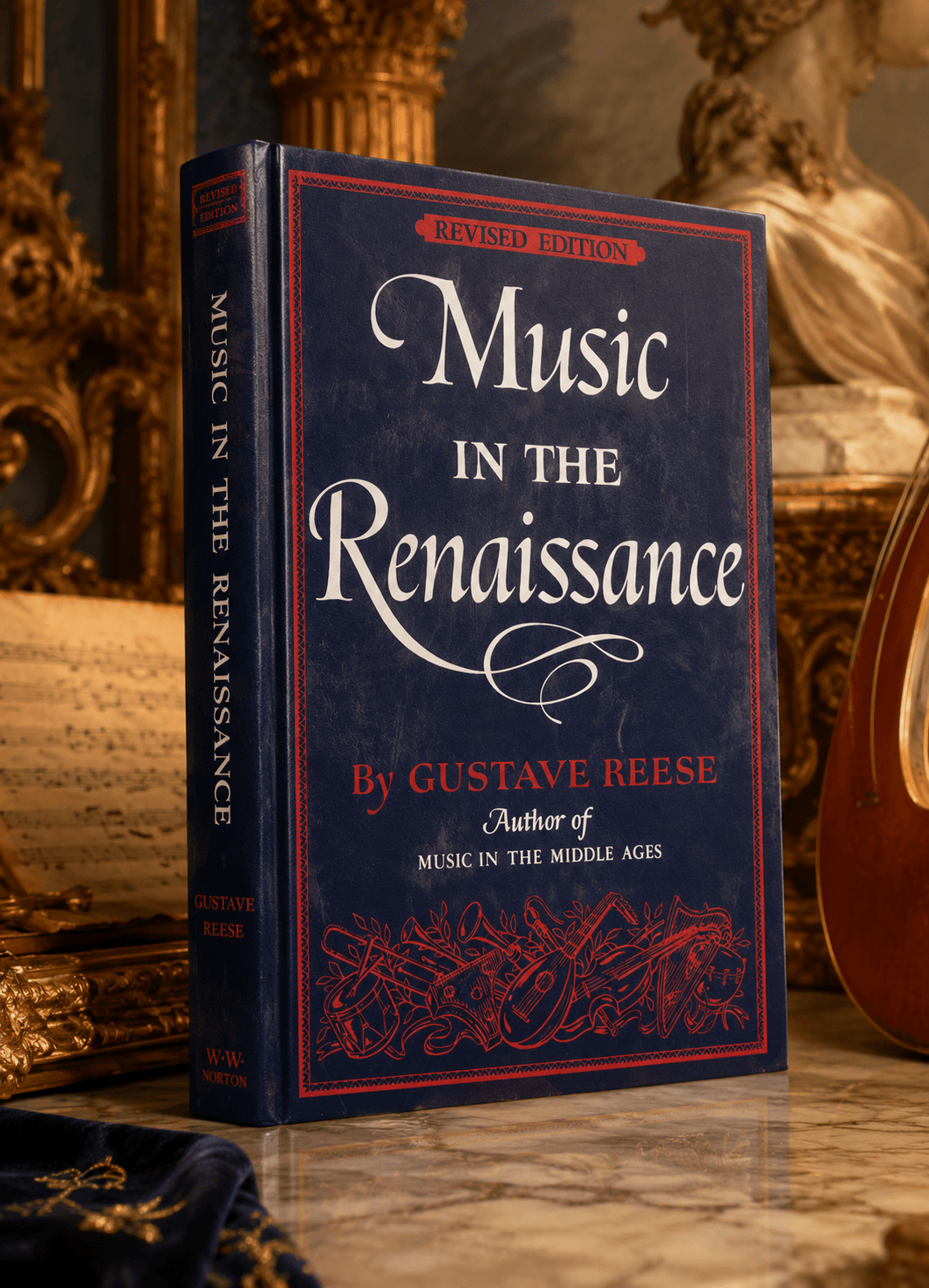
Book Description
Music in the Renaissance by Gustave Reese is a monumental study of Renaissance music, early music history, sacred polyphony, secular song, composers, national schools, notation, theory, and performance context. Across more than one thousand pages, Reese offers a vast map of musical life from the fifteenth and sixteenth centuries, connecting repertories, institutions, styles, and sources. It is especially valuable for students, teachers, performers, composers, and researchers who want to understand Renaissance music not as isolated masterpieces, but as a rich historical world.
Who this book is for?
This book is ideal if you want to:
Explore Renaissance music in real depth.
Understand sacred polyphony historically.
Study madrigals, chansons, and motets.
Connect composers with cultural context.
Build stronger early music foundations.
What will you learn?
In Music in the Renaissance, you will learn how European music developed across the Renaissance through composers, countries, institutions, genres, and changing musical languages.
The book helps you understand Renaissance polyphony in context. Instead of treating Josquin, Palestrina, Lassus, Byrd, Victoria, or Willaert as isolated names in a textbook timeline, Reese places them inside a broader historical landscape of courts, churches, chapels, printers, cities, schools, and musical traditions.
You will also learn why Renaissance music cannot be reduced to one style. The book moves through sacred music, secular music, national repertories, vocal genres, instrumental traditions, notation, sources, and stylistic change. It is not a quick guide. It is a large library in one volume.
Book Overview
This review of Music in the Renaissance can be summarized clearly: it is one of the great classic reference works for anyone serious about Renaissance music.
The revised edition was published by W. W. Norton & Company in 1959. WorldCat lists the revised edition as published by Norton in New York, with ISBN 9780393095302 and 0393095304. Amazon lists the same revised edition with publication date November 17, 1959, English language, and 1040 pages.
As a summary, the book offers a comprehensive analysis of music during the Renaissance, including the contributions of different countries and traditions. Some listings describe its method as a “Ring and the Book” technique, meaning that the reader returns to the historical outline more than once, each time with different musical details and perspectives.
Is it worth it? Yes, if you want a serious historical foundation. This is not the lightest book on Renaissance music, and it is not meant to be. It is large, detailed, sometimes old fashioned in tone, but still extraordinarily useful. For the right reader, it feels less like a textbook and more like entering a huge archive with a very patient guide.
Topics Covered
Broad history of Renaissance music across Europe.
Development of sacred polyphony and church repertories.
Study of secular song, madrigal, chanson, and related genres.
Major Renaissance composers and national schools.
Context for notation, sources, printing, and transmission.
Connections between music theory, style, and practice.
A bridge between music history, analysis, and composition.
About the Author
Gustave Reese was an American musicologist, teacher, and editor, born in 1899 and died in 1977. The New York Public Library describes him as best known for Music in the Middle Ages and Music in the Renaissance, with the latter first published in 1954 and revised in 1959.
Reese divided his career between publishing and academia. NYPL notes that he worked as director of publications for G. Schirmer and Carl Fischer, and that his teaching at New York University and other institutions helped shape American musicology.
This background matters because Music in the Renaissance is not just a compilation of facts. It reflects a scholar deeply involved in teaching, editing, bibliography, and the recovery of early music as a serious academic field.
Why this book is worth it
Music in the Renaissance is worth it because it gives depth, scale, and historical orientation to a repertory that is often studied in fragments.
For students, the book provides a vast foundation in early music history, composers, genres, institutions, and sources. It helps connect the dots between pieces that might otherwise seem unrelated.
For performers, it offers historical context for motets, masses, chansons, madrigals, instrumental music, and sacred traditions. Even if performance practice has developed since Reese’s time, the historical map remains valuable.
For composers and theorists, the book is useful because it places counterpoint, modal thinking, imitation, text setting, and polyphonic style inside the living world that produced them. That matters if you want to compose in historical styles with more than surface imitation.
For readers of Musicus Practicus, this book belongs beside counterpoint, partimento, harmony, and historical composition methods. It reminds us that musical craft always belongs to a culture, a repertory, a set of institutions, and a way of hearing.
Buy this Book on Amazon
You can buy Music in the Renaissance by Gustave Reese on Amazon. If you study Renaissance music, early music history, sacred polyphony, madrigals, chansons, motets, or historical composition, this is a major reference book to consider.
It is especially recommended if you want a broad, serious, and richly documented overview of the musical world of the Renaissance.
FAQ on this Book
Is this book mainly about composers or musical styles?
It covers both. Reese discusses Renaissance composers, but also places them within genres, institutions, national traditions, sacred and secular repertories, and stylistic change.
Is this book too large for casual reading?
It is large and detailed, so it is better for serious study than casual reading. But motivated readers can use it by reading selected chapters on topics, composers, or countries.
Is Music in the Renaissance useful for counterpoint study?
Yes. It is not a counterpoint manual, but it gives essential historical context for Renaissance counterpoint, sacred polyphony, imitation, modal thinking, and vocal genres.
Continue Your Journey as a Musicus Practicus
If you desire to stop looking at early music from the outside and wish to step inside the musical mind of the 15th and 16th centuries, there are three distinct ways we can work together to elevate your skills:
- 1-to-1 Musical Apprenticeship: For a personalized, tailor-made path, book private lessons with me. We will work directly on your specific goals, from counterpoint to improvisation, Renaissance and Baroque composition, theory and practice, exactly as a master and apprentice would have done centuries ago.
- Patreon Support & Exclusive Content: Join our growing community of true Musici Prattici on Patreon!
Gain access to exclusive insights, behind-the-scenes materials, and support the ongoing creation of these deep-dive musical analyses.- The Musicus Practicus Academy (MPA): Enroll in my comprehensive on-demand courses.
Start with the free levels, and master the art of Renaissance and Baroque music step-by-step at your own pace.



All Rights Reserved - Richardus Cochlearius 2026