A Practical Approach to Sixteenth-Century Counterpoint
Getting Started with Species Counterpoint
A useful method for students, composers, and teachers who want to learn Renaissance polyphony through direct writing rather than abstract rules alone.
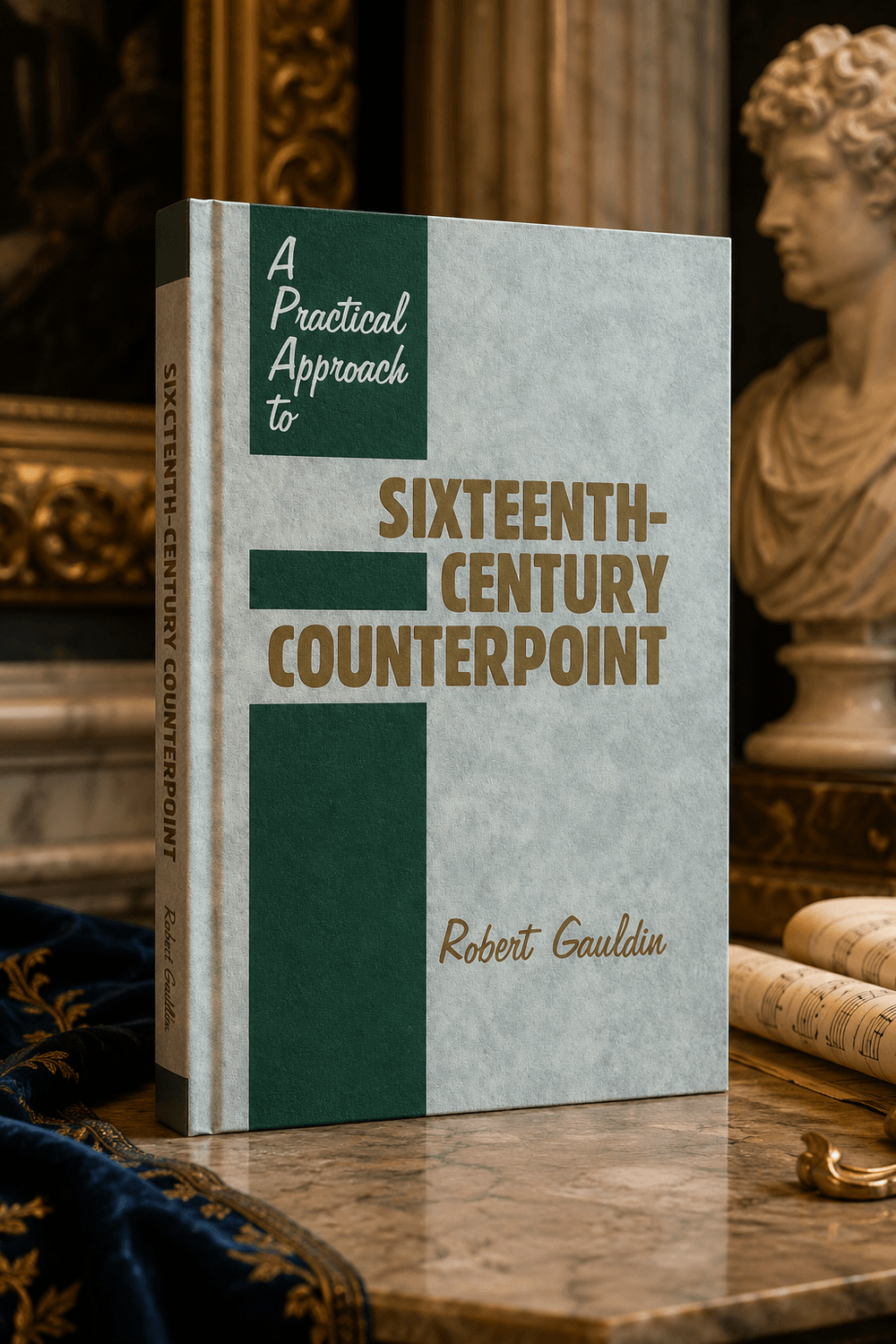
Book Description
A Practical Approach to Sixteenth-Century Counterpoint by Robert Gauldin is a clear and hands on textbook for studying Renaissance counterpoint, sixteenth century sacred polyphony, modal writing, imitation, cadence, and vocal style. Rather than treating counterpoint only as a set of isolated species exercises, the book emphasizes practical writing skills and the simulation of real sacred polyphonic idioms. It is especially valuable for students, composers, teachers, theorists, and early music performers who want to understand Renaissance polyphony as a living craft of line, texture, and musical grammar.
Who this book is for?
This book is ideal if you want to:
Study Renaissance counterpoint through writing.
Practice sixteenth century polyphony directly.
Understand modal writing and cadence.
Improve voice leading in vocal style.
Build stronger historical composition skills.
What will you learn?
In A Practical Approach to Sixteenth-Century Counterpoint, you will learn how to write in a style modeled on sixteenth century sacred polyphony, with attention to line, texture, modal organization, imitation, and cadential motion.
The book is designed to build contrapuntal writing skills rather than simply describe historical style from a distance. Waveland’s description emphasizes the acquisition of writing skills and the simulation of sixteenth century sacred polyphonic idioms, which makes the method especially useful for students who want to compose, not only analyze.
You will also learn a more direct approach to Renaissance style. The publisher describes Gauldin’s method as a non species or direct approach, meaning the student is guided toward practical idiomatic writing rather than only passing through the traditional species ladder.
Book Overview
This review of A Practical Approach to Sixteenth-Century Counterpoint can be summarized simply: it is a practical counterpoint textbook for musicians who want to write Renaissance style polyphony with real stylistic awareness.
The book was published by Waveland Press, and Google Books lists the 1995 edition with ISBN 9780881338522 and 312 pages. The publisher’s description presents it as a volume focused on practical work in counterpoint, especially the simulation of sixteenth century sacred polyphonic idioms.
As a summary, the book belongs to the same practical world as Gauldin’s companion volume on eighteenth century counterpoint. Here, however, the focus is Renaissance sacred vocal style rather than late Baroque tonal counterpoint. That means the musical priorities are different: modal counterpoint, singable melodic lines, balanced textures, controlled dissonance, and cadences that arise from the movement of voices.
Is it worth it? Yes, especially if you want a book that makes you write. Reading about Renaissance counterpoint is helpful, but the style only begins to make sense when you try to build it yourself. Gauldin’s strength is that he treats counterpoint as a craft learned through doing, correcting, hearing, and trying again.
Topics Covered
Practical training in sixteenth century counterpoint and writing.
Simulation of Renaissance sacred polyphony and vocal idioms.
Development of modal counterpoint and melodic control.
Work on voice leading, cadence, and textural balance.
Direct approach beyond strict species counterpoint formulas.
Skills for composing imitative polyphony in historical style.
A bridge between music theory, analysis, and composition.
About the Author
Robert Gauldin was an American theorist, composer, and professor emeritus of music theory at the Eastman School of Music. Eastman notes that he began teaching there in 1963 and had earlier taught theory at William Carey College.
Gauldin is also known for other widely used textbooks, including A Practical Approach to 18th Century Counterpoint and Harmonic Practice in Tonal Music. His work is strongly associated with practical theory pedagogy, where analysis and writing are treated as connected musical skills.
That background matters for this book. A Practical Approach to Sixteenth-Century Counterpoint is not written like a purely historical survey. It reflects the mindset of a composer and teacher who wants students to understand style through actual musical production.
Why this book is worth it
A Practical Approach to Sixteenth-Century Counterpoint is worth it because it teaches Renaissance counterpoint as a practical discipline rather than a museum topic.
For composers, the book offers a way to develop fluency in modal writing, vocal line, imitation, cadence, and polyphonic texture. These skills remain valuable even for modern composition because they train the ear to think horizontally and structurally.
For students, the direct approach can be refreshing. Traditional species counterpoint is useful, but it can sometimes feel detached from actual music. Gauldin’s method aims more directly at the sound and behavior of sixteenth century sacred idioms.
For teachers, the book provides a structured way to connect writing assignments with historical style. It can support a course where students do not merely label intervals, but learn how Renaissance polyphony breathes.
For readers of Musicus Practicus, this book fits naturally beside partimento, counterpoint, harmony, and historical composition methods. It shares the same core idea: theory becomes powerful when it becomes something you can practice.
Buy this Book on Amazon
You can buy A Practical Approach to Sixteenth-Century Counterpoint by Robert Gauldin on Amazon. If you study Renaissance counterpoint, sixteenth century polyphony, modal writing, sacred vocal music, or historical composition, this is a practical and serious book to consider.
It is especially recommended if you want a counterpoint method that moves quickly toward real stylistic writing, rather than staying only with abstract exercises.
FAQ on this Book
Does the book require previous counterpoint study?
The publisher says no previous contrapuntal training is necessary, though some familiarity with Baroque polyphonic terminology can be helpful.
Is this book good for self study?
Yes, especially for disciplined readers who already read notation well and are willing to write exercises carefully. Feedback from a teacher can still make the process much stronger.
How does it compare with Gauldin’s eighteenth century counterpoint book?
This book focuses on Renaissance modal polyphony, while Gauldin’s eighteenth century volume focuses on late Baroque tonal counterpoint, canon, invention, fugue, and related forms.
Continue Your Journey as a Musicus Practicus
If you desire to stop looking at early music from the outside and wish to step inside the musical mind of the 15th and 16th centuries, there are three distinct ways we can work together to elevate your skills:
- 1-to-1 Musical Apprenticeship: For a personalized, tailor-made path, book private lessons with me. We will work directly on your specific goals, from counterpoint to improvisation, Renaissance and Baroque composition, theory and practice, exactly as a master and apprentice would have done centuries ago.
- Patreon Support & Exclusive Content: Join our growing community of true Musici Prattici on Patreon!
Gain access to exclusive insights, behind-the-scenes materials, and support the ongoing creation of these deep-dive musical analyses.- The Musicus Practicus Academy (MPA): Enroll in my comprehensive on-demand courses.
Start with the free levels, and master the art of Renaissance and Baroque music step-by-step at your own pace.



All Rights Reserved - Richardus Cochlearius 2026