The Langloz Manuscript: Fugal Improvisation through Figured Bass
The Langloz Manuscript: Fugal Improvisation through Figured Bass
Is The Langloz Manuscript worth it for mastering baroque improvisation?
If you want to move beyond basic harmony and learn to improvise complex fugues, this historical resource is an essential investment for your library.
Book Description
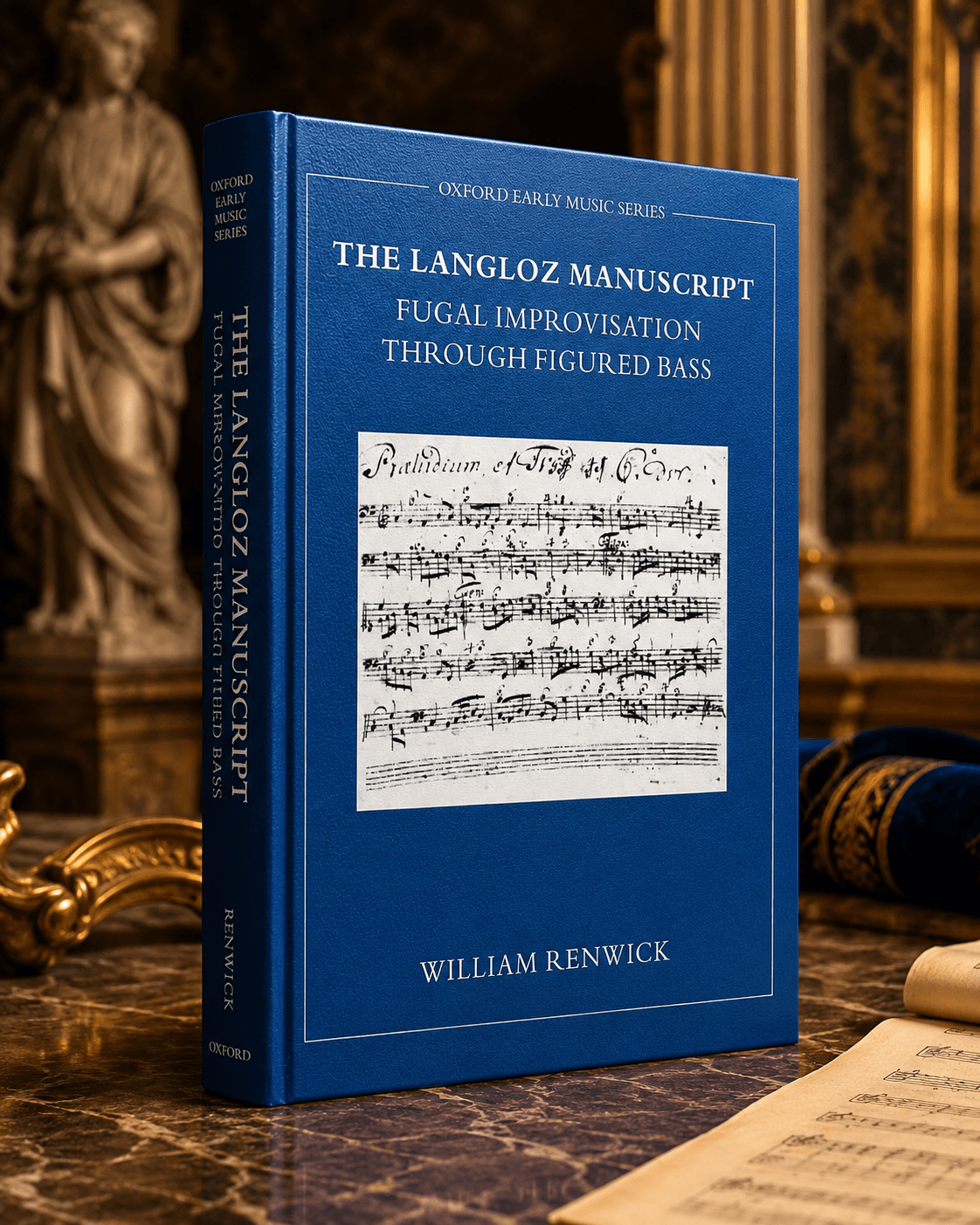
The Langloz Manuscript: Fugal Improvisation through Figured Bass, edited and analyzed by William Renwick, is a landmark publication in historical music theory. It presents a collection of 18th-century keyboard exercises that bridge the gap between thoroughbass and fugue. This edition provides the necessary tools to understand how the great masters of the Baroque era taught their students to improvise entire polyphonic works from a single, carefully figured bass line.
Who this book is for?
This book is ideal if you want to:
Explore the advanced pedagogical methods used by Johann Sebastian Bach and his contemporaries.
Transition from basic accompaniment to the art of extemporaneous fugal composition at the keyboard.
Deepen your understanding of the relationship between linear counterpoint and vertical harmony.
Master the specific rules of voice-leading required for authentic historical performance and composition.
What will you learn?
You will learn the systematic process of expanding a figured bass into a full four-voice fugue. The book teaches you how to identify fugal subjects hidden within the bass and how to apply the correct countersubjects. By studying these historical examples, you will develop a "polyphonic ear" that allows you to manage multiple independent voices simultaneously while maintaining harmonic clarity and stylistic integrity.
Book Overview
You will learn the systematic process of expanding a figured bass into a full four-voice fugue. The book teaches you how to identify fugal subjects hidden within the bass and how to apply the correct countersubjects. By studying these historical examples, you will develop a "polyphonic ear" that allows you to manage multiple independent voices simultaneously while maintaining harmonic clarity and stylistic integrity.
Topics Covered
The historical context of the manuscript and its direct connection to the pedagogy of J.S. Bach.
Detailed instructions for the preparation and execution of fugal answers and tonal mutations.
A complete collection of 37 preludes and fugues designed for practical keyboard realization and study.
Structural analysis of how figured bass symbols dictate complex imitation and contrapuntal textures.
The evolution of the German keyboard tradition from the time of Pachelbel to the late Baroque.
Comparative studies showing the link between these exercises and Bach's Well-Tempered Clavier.
About the Editor
While the original exercises were compiled in the 1700s, this edition is brought to life by William Renwick. He is a Professor of Music Theory and a renowned expert in Schenkerian analysis. Renwick’s scholarly work has been instrumental in reviving interest in the historical methods of composition, making him the perfect authority to curate and explain this complex manuscript.
Why this book is worth it
For the serious student of historical composition, this book is a goldmine of practical information. It provides a "missing link" between the Italian partimento tradition and the rigorous counterpoint of the North. It is absolutely worth it because it transforms abstract theory into a tactile, hands-on experience that will permanently improve your ability to visualize and hear musical structures.
Buy this Book on Amazon
You can check the book and its current availability here:
FAQ on this Book
Is this book a tutorial or a collection of music?
It is both a scholarly study and a practical workbook containing the original musical exercises for you to realize.
Do I need to be an expert organist to use this book?
You should have a solid foundation in figured bass and intermediate keyboard skills to get the most out of it.
Is William Renwick the composer of these pieces?
No, he is the editor and researcher who provides the historical commentary and ensures the accuracy of the musical text.
Continue Your Journey as a Musicus Practicus
If you desire to stop looking at early music from the outside and wish to step inside the musical mind of the 15th and 16th centuries, there are three distinct ways we can work together to elevate your skills:
- 1-to-1 Musical Apprenticeship: For a personalized, tailor-made path, book private lessons with me. We will work directly on your specific goals, from counterpoint to improvisation, Renaissance and Baroque composition, theory and practice, exactly as a master and apprentice would have done centuries ago.
- Patreon Support & Exclusive Content: Join our growing community of true Musici Prattici on Patreon!
Gain access to exclusive insights, behind-the-scenes materials, and support the ongoing creation of these deep-dive musical analyses.- The Musicus Practicus Academy (MPA): Enroll in my comprehensive on-demand courses.
Start with the free levels, and master the art of Renaissance and Baroque music step-by-step at your own pace.



All Rights Reserved - Richardus Cochlearius 2026